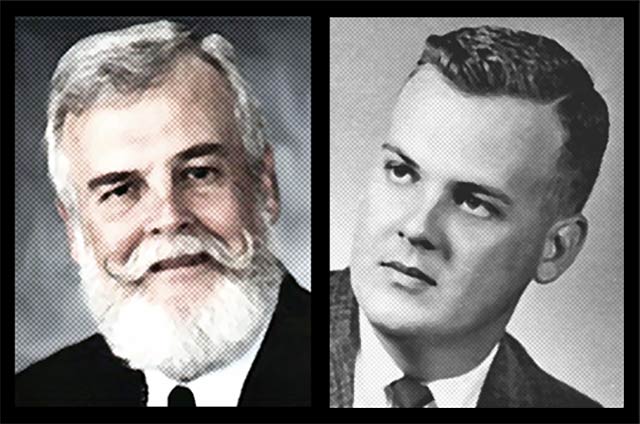
Ed Barber died over the weekend. While he’ll rightly be honored, my memories of him are mixed.
The 86-year-old Miami native was literally legendary…
- More people knew of him than knew him.
- He’d been around forever.
- Other people told stories about his exploits (because he was too modest to boast about himself).
This legend starts in 1976, when mild-mannered Ed Barber became general manager of a nearly broke college paper. Before he retired 30 years later, The Independent Florida Alligator had grown into the nation’s largest student newspaper by circulation.
It was also the nation’s most award-winning newspaper for much of that span – which was weird, since it’s located far from the prestigious j-schools in the media capitals of Chicago, Los Angeles, and New York City.
The Alligator’s decrepit building was a few blocks from the University of Florida, in the hick town of Gainesville. It’s an hour drive just to get to the thriving metropolis of…Orlando.
Mr. Barber’s contribution to that boom in both circulation and awards had less to do with his business acumen than with his personal ethics. The Alligator graduated excellent journalists – working at The New York Times, Washington Post, and Wall Street Journal, and winning multiple Pulitzers – precisely because Mr. Barber only once interfered with the students who ran the newsroom. Basically, Mr. Barber was legendary for what he didn’t do but could have.
Except for that one time.
In March 1989, The Alligator board of directors ordered the editor to fire me as entertainment editor. When the editor didn’t, the board suspended him for a week. (Weirdly, while he wasn’t allowed in the newsroom, I was.) The staff threatened to walk out, and they removed their bylines from an issue in protest.
A half-dozen Florida newspapers reported the chaos and irony of “the largest absolutely independent student paper in America” being bossed around by its board. Everyone but Mr. Barber was quoted in that story. But he was still at the center of it, just as he was at the center of every Alligator controversy. Even the ones nobody covered.
Like most legends, Mr. Barber’s mistakes are more interesting and enlightening than his successes. This is my memory of the man, good and bad.
“Fuckin’ Mr. Barber”
When I started at The Alligator in 1984, the editor was a temperamental 27-year-old named Brad Liston. He hated Mr. Barber. As a newbie – a “stringer” – I never knew exactly why, but I gleaned it had something to do with page count.
While Mr. Barber prided himself on letting the students print whatever they wanted, he controlled how many pages were in each daily issue, which pages contained ads. That made sense, since he was responsible for revenue and expenses.
As a former Alligator reporter himself back in the early ’60s – he won a national Hearst award for editorial writing – Mr. Barber encouraged editors to negotiate with him. If they had a breaking story or major investigation, he might rearrange the ads or even print more pages.
Of course, he often said no, which aggravated some editors. It angered Liston so much, he apparently forbade Mr. Barber from setting foot “in my newsroom.”
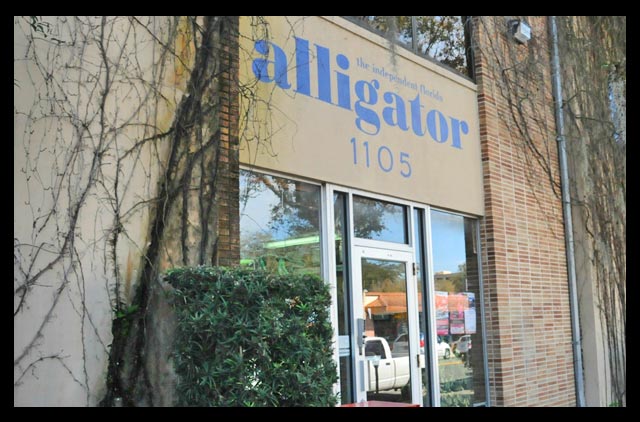
Over four decades, The Alligator newsroom filled the middle of a dingy building on West University Avenue, just a few blocks from campus. The business, advertising, and production offices wrapped around the newsroom, connected by a meandering hallway. It was quite common for employees in those departments to cut through the newsroom to get where they needed to go.
But for the rest of Liston’s six-month term as editor, Mr. Barber took the long way around. For my first few weeks at The Alligator, I never saw the man. I only heard his name, usually preceded with “fucking” or followed by “that asshole.”
Such was the respect he commanded, it was always, “fuckin’ Mr. Barber” and “Mr. Barber, that asshole.” From then on, I only ever knew him as Mr. Barber, even when he and I later fought over that single incident of editorial interference.
When I finally became editor myself, I asked Mr. Barber about Brad Liston. We were sitting in his office during one of our informal meetings, and he leaned back in his squeaky wooden chair. He explained he heeded Liston because “It really was his newsroom, Michael. Now it’s yours.”
“Come on, Mr. Barber, that guy was such an asshole,” I said. “Didn’t he piss you off even a little bit?”
This was the first of many times I heard Mr. Barber deflect negative questions about his personal feelings. God knows I didn’t take notes, but I recall him saying something like, “This newspaper has its nonprofit status because it is an educational institution. Then he leaned forward, the chair groaning with another long squeak, and he grinned. “Fortunately, Michael, not all the lessons here are about journalism. Certainly not the most important ones.”
Nice guys last
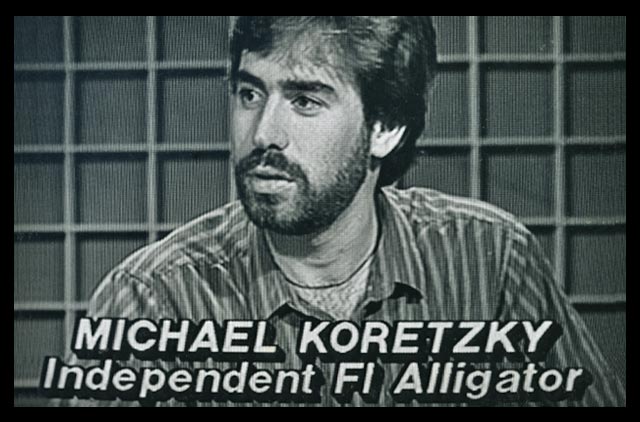
Before I was elected editor by The Alligator’s board of directors, I ran twice and lost badly. I cumulatively got one vote – from Dana McElroy, now a noted media attorney who announced at the time, “I just feel so bad for him.”
Mr. Barber must’ve seen I was discouraged by this single pity vote. I figure that’s why, after both crushing defeats, I found a small envelope in my mail slot in the newsroom. Inside was a card from Mr. Barber. Maybe he did this for all pathetically losing candidates, I don’t know.
I wish I’d kept those cards, because I don’t remember their exact words. Both encouraged me to learn from the beating and run again. He also invited me to stop by his office, which seemed regal to a college student but now when I think about it, was actually spartan yet warm, with creaky wooden furniture and a worn area rug I imagine lasted his entire 30 years on the job.
When Barber asked me about my family, I told him my parents had recently divorced. I didn’t realize at the time how important family was to him, or how it would later make him famous beyond The Alligator.
Looking back, I’m guessing Mr. Barber took an interest in me because he’d been working at The Alligator as a student, employee, or GM for two decades by the time I met him. He could see I was a little lost both personally and professionally, even though I didn’t see it myself.
I did realize I was immature but hard-working and talented – those traits in that order. Mr. Barber seemed bent on keeping the first trait from swamping the others, so he’d occasionally ask me to stop by his office. I don’t recall what we discussed, but I remember feeling intimidated by his presence, while also thinking our conversations were a waste of time. I mean, he didn’t have anything to do with the newsroom or the editor selection, so why was I here? I was too dense to notice the soothing wisdom in his small talk, or understand it was keeping me sane.
When I finally became editor in 1987, Mr. Barber literally poked his head into the editor’s office. With that trademark grin, he asked, “Is it OK if I visit your newsroom?”
It was more than OK. Until 1989, when it wasn’t.
Doubts come out
Not long after Barber first set foot in “my” newsroom, I obsessively cleaned the editor’s office. It was my way of making the place mine. I even bought a used couch to replace the one that had been soiled by a decade of student sex.
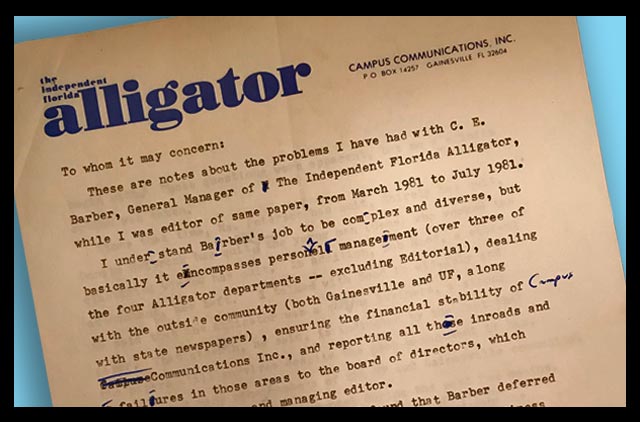
In one corner of the office was a dented, black, four-drawer file cabinet whose bottom two drawers were crammed with bent folders. Being compulsive by nature, I spent several hours reading and tossing everything in those drawers. By the time I was done, I found a memo that had apparently fallen from its folder to the bottom of the bottom drawer.
It was four sloppily typewritten pages on Alligator stationery. It began like this…
To whom it may concern:
These are notes about the problems I have had with C.E. Barber, General Manager of The Independent Florida Alligator, when I was editor of same paper, from March 1981 to July 1981.
I remember thinking: What Liston-like asshole was editor in 1981? I flipped to the last page. It was signed by David Dahl, then a respected St. Petersburg Times reporter, later deputy managing editor at The Boston Globe. Definitely not an asshole.
Dahl’s letter documented Barber’s poor record of hiring, managing, and retaining staff. (“It seems to me Barber is not doing his job in the area of personnel management, nor in dealing with the community.”) It also criticized his fiscal leadership…
In regard to Barber’s abilities to secure financial stability, I feel he has failed in many respects. He has said for months he is attempting to secure grants to aid The Alligator. None have come forth. When I went to San Francisco to the Hearst contests, I talked with a representative of the Hearst Foundation and received some information about getting a grant from them. I showed some of that information to Barber, but he showed little interest…
I don’t see how it is possible, in some eight years of independence from UF, that The Alligator has failed to secure a major grant from state newspapers (which we supply regularly with reporters) from Hearst (which we win regularly) and from other educational philanthropic organizations. This failure reflects on Barber’s abilities.
Here’s how Dahl’s letter ended…
In conclusion, we are left with the final question: just what does Ed Barber do or $23,000 or so a year [$76,700 today]? It doesn’t look like much. He has deferred authority to an inadequate worker, who he gave a raise. He has failed to give The Alligator financial stability. He has failed to keep an advertising director here, though it is obvious a permanent director would do wonders for revenue.
I sadly say that I am one of the members of the board of directors that voted to give another five-year contract to Mr. Barber. I did so early in my editorship, when I still believed he was worth the money. If I had that moment back, I would vote against approval of the contract. Instead, we are left with a long-term pact with a man with failing health, who doesn’t do his job well.
If there was any way to get out of this contract, I would do it.
I was stunned. The only criticism I’d ever heard of Mr. Barber came from Liston, and that was melodramatic crap. This letter was from a good journalist accusing a great man of doing a bad job.
I remember sitting on the floor rereading Dahl’s letter a few more times. I don’t remember how long I just sat there, just blinking and thinking.
The Barber shop
Dahl’s letter stuck to me like it had gone through the wax machine in the back shop. I started noticing things and remembering things.
Mr. Barber had indeed talked constantly about getting grants from The Miami Herald, Orlando Sentinel, St. Petersburg Times, and other Florida newspapers. For years, he told me the newsroom would soon replace its manual typewriters with new computers.
But our first computers were three portable “Trash 80” Model 100s that managing editor David Scruggs bought in 1985 by squeezing the newsroom budget. They only displayed eight lines of text, and you had to save your stories on a tape recorder. But at least you didn’t need an X-acto knife, gluepot, and Ebony pencil.
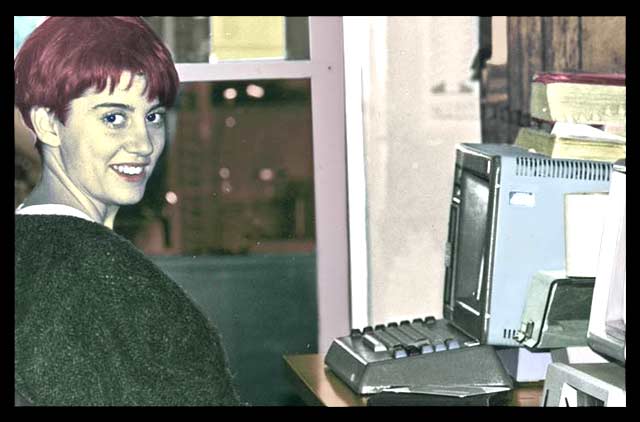
Two years later, after an internship at The Florida Times-Union, I begged the bosses there to give us nine of their old Telerams that were being replaced with state-of-the-art PCs. These were the newsroom’s first desktop computers. (That’s Alligator editor Sonja Isger typing on one in the photo above.)
I later learned Mr. Barber included these acquisitions in his fiscal-year-end report to the board. But he had nothing to do with them. That made me wonder what other Alligator successes he’d claimed as his own.
Don’t get me wrong, I still admired the man. Just not the businessman.
Five years after leaving UF and The Alligator, I sold a magazine to the Tribune Company. I was editor and publisher, and part of the latter job meant networking at long luncheons and boring banquets to promote the weekly.
At one of those stupid events, I remember thinking, “Did Mr. Barber ever go to Chamber of Commerce mixers to promote The Alligator? Did he chat up potential advertisers while also telling them no, they couldn’t have a puff piece written about them? Because I hate this, even though it’s important.”
If Mr. Barber did rep The Alligator to others, I never heard about it. And I was the first Alligator editor to serve back-to-back terms, so I got to study him longer than most.
I quickly learned Mr. Barber was uneasy about change. One example: When I was elected editor in 1987, businesses were just beginning to widely adopt sexual harassment policies. I cribbed one from another nonprofit and asked The Alligator board to adopt it. But Barber opposed it – politely, of course.
“It’s just not needed,” I recall him saying softly. “We don’t have a sexual harassment problem here, Michael.”
I countered, “You’re supposed to have policies to prevent problems.” He gently shook his head, and the board followed his lead – which was another problem. The board blindly obeyed Mr. Barber, because he was already a charming legend while they were just very part-time directors. By never challenging him, they never improved him.
When my reign was over, I concluded: Mr. Barber’s hands-off policy helped the newsroom but not the newspaper. And the one time he got his hands dirty in editorial, it hurt everyone.
The Applause incident
When I finished as editor, I wasn’t finished with school. My GPA during my second term was a 0.66. Barber silently shook his head when I told him.
Barber knew I was too personally invested in The Alligator to leave – something he’d seen quite often. But he urged me to “take on a smaller role.”
I wonder if he regretted that.
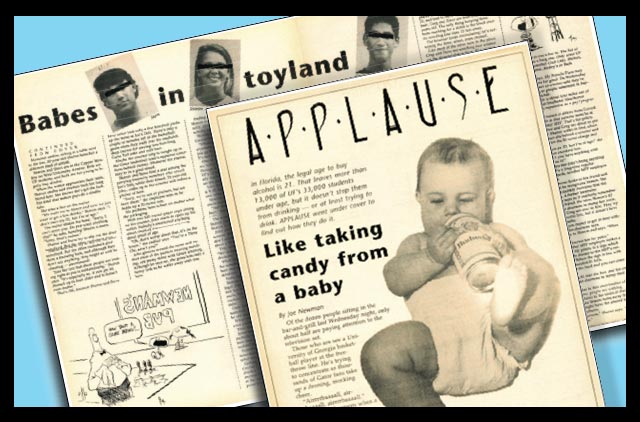
I eventually became editor of Applause, the weekly arts & entertainment supplement that filled the middle 8 to 12 pages of each Thursday’s issue. With a small staff of other Alligator malcontents and rejects, we remade Applause into an alternative magazine.
That meant how-to stories about frugally buying pot, safely eating roadkill, and successfully drinking in bars while underaged, plus an expose on gay bathroom sex that was lurid enough to earn a call from an Oprah producer. (This was way before she was a stateswoman.) Today, such stories wouldn’t raise an eyebrow, much less the roof. But remember, this was the last gasp of the Reagan ’80s.
The breaking point, as usual, wasn’t a big story but a little one. We ran a contest giveaway most weeks, which involved calling our answering machine and leaving a message for free tickets to whatever swag the Applause staff couldn’t ethically keep for itself.
We made these contests as immature as possible. Example: To win your choice of a free record – this was pre-CD – you needed to do some math. “What was the weight difference between Elvis Presley and Karen Carpenter at the time of their deaths?” This was pre-Internet, too, so it wasn’t a gimme.
On a particularly uninspired week, we simply ran a disgusting joke contest: Leave your worst joke on our answering machine – this was also pre-voice mail – and win a free record.
The winning joke was truly awful: “What’s the definition of relative humidity? The sweat on your balls after you fuck your little sister.” Almost everyone on the small Applause staff, man and woman, was repulsed. (Except for music writer Tom Nordlie. I recall he shook his head and chortled in his weird way that always made me laugh.)
Usually, we’d announce the winners the following week, then introduce the next contest. I clearly hadn’t thought this through, because there was no way I was printing that disgusting joke. After consulting the rest of the small staff, we wrote…
Last week, we asked callers to tell us their most disgusting joke, and this week we have a winner. However, because of the nature of this contest, we do not feel it appropriate to repeat the joke in print. (Didn’t expect us to have a sense of decency, did you?)
So you’re just going to have to call the APPLAUSE Hotline at 276-4511 to hear this very, very disgusting joke.
…and then we forgot all about it. Until a day later, when I learned The Alligator’s advertising director had opened our locked office with a master key and seized our answering machine.
Mr. Barber was out of town, and when I demanded the ad director return our answering machine, she folded her arms and replied resolutely. “We’ll just wait until Mr. Barber gets back.” It sounded very much like, “Wait until your father gets home!” (Sorry, I grew up in a traditional 1970s IBM household.)
“OK, fine,” I recall saying, because I knew Mr. Barber would side with me – no way the ad department could break into the newsroom and steal our equipment.
Except when Mr. Barber got back the next day, he had a look on his face I’d never seen before, not even after Brad Liston had banned him from the newsroom. He was sneering. I’d never seen him do that.
I first saw him walking down the hallway by his office, and I said, “Hey, Mr. Barber!” He shot me that sneer, silently motioned to his office, and showed me his back on our walk there. Probably took five seconds. Seemed like five minutes.
Mr. Barber told me I had embarrassed The Alligator and exposed it to hefty fines and possible legal action. By putting that sick joke on an answering machine, I was broadcasting it – thus violating FCC profanity rules.
I don’t recall his exact words, because I was more than little freaked out. But I remember this: “Your antics could bankrupt The Alligator.”
Mr. Barber said he’d convene the board of directors to decide what would happen next. Then he said goodbye – politely, of course – and turned away from me to read some papers on his desk.
I didn’t know that would be the last time Mr. Barber would say a word to me for nearly five years.
Idle threats and cold sweats
Back at my apartment, I paced and fretted. The Alligator and my journalism career were both doomed by one disgusting joke that wasn’t funny?
That can’t be right.
I fetched the Yellow Pages – yes, the phone book – and looked up Gainesville attorneys. I called around and offered $50 for a phone consultation. That’s $125 today.
I don’t remember who I finally reached, or what he said exactly. I do remember he laughed. Then he told me I hadn’t broken any laws, FCC rules, or anything else. He dictated a short statement, told me I could use his name, and charged me nothing.
I wrote a letter to Mr. Barber that quoted the attorney. I handed it to him and said the attorney would be willing to talk. But Mr. Barber didn’t talk to me. He took the letter and nodded, then walked away.
Mr. Barber still called a board meeting. The board – with Mr. Barber’s approval, of course, because it never did anything he didn’t authorize – demanded my firing.
Thing is, only one board member could do that: the editor in chief. And when he refused – because his staff threatened a walkout – the board suspended him.
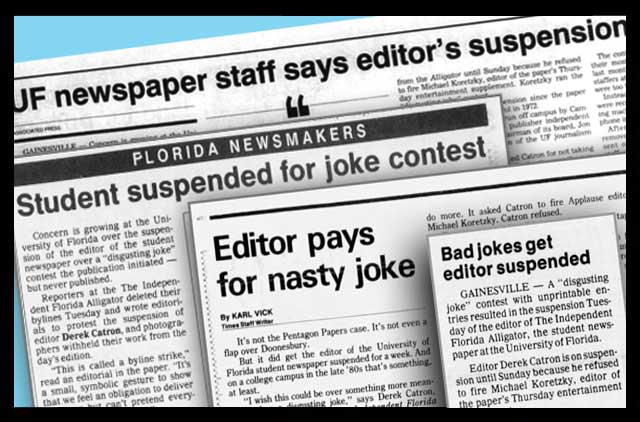
As the Fort Myers News-Press reported, “It’s the first time an editor has been suspended since 1972, when the newspaper broke away from the university to become independent.”
The next issue of The Alligator had no bylines, and the editorial that day began…
This is called a byline strike. It’s a small, symbolic gesture to show that we feel an obligation to deliver the news but can’t pretend everything is business as usual.
The Gainesville Sun, Florida Today, Orlando Sentinel, and St. Petersburg Times also covered the twisted situation. You can’t find these via Google, so here’s the St. Pete Times’ story, which is the most bemused. Notice how Mr. Barber is nowhere to be found, even though none of this could’ve happened without his encouragement or blessing…
Editor pays for nasty joke
By KARL VICK
St. Petersburg Times
It’s not the Pentagon Papers case. It’s not even a flap over Doonesbury. But it did get the editor of the University of Florida student newspaper suspended for a week. And on a college campus in the late ’80s that’s something, at least.
“I wish this could be over something more meaningful than a disgusting joke,” says Derek Catron, whose term as editor of the Independent Florida Alligator has been not ended, but interrupted.
The joke at issue did not even appear in the newspaper. It was recited into a telephone answering machine for playback to anyone dialing a number that appeared in Applause, the Alligator’s regular Thursday entertainment section.
The joke, which involved incest, was the winning entry of the section’s Disgusting Joke Contest. When Tricia Carey heard it, she went to the Applause staff and “…I guess I screamed at somebody,” she says.
Carey, the Alligator’s advertising director, was not greatly offended. “To tell you the truth,” she says, “I’ve heard worse jokes.” But she was horrified at the possible legal ramifications of the Alligator promoting a possibly obscene recording.
After trying for a full day to alert Alligator officials, she disconnected the machine herself. And when editor Catron returned from a weekend conference, he instituted mild reforms to check the Applause staff in the future.
The newspaper’s board of directors said he should do more. It asked Catron to fire Applause editor Michael Koretzky. Catron refused.
For one thing, he didn’t agree that the tape exposed the newspaper legally.
“What’s the legal test the lawyers mention for obscenity? Community standards? Our community would be the university, and it would be hard to prove anything is obscene to thousands of university students,” Catron observes.
But the bigger issue, the editor decided, was whether the board should tell the editor what to do.
At the Independent Alligator, it’s an especially big issue. The newspaper prides itself on being the largest absolutely independent student paper in America. With off-campus offices, it has had no official connection with the University of Florida since 1972.
When it still did, at least two student editors were fired after publishing criticism of university officials. Today, the board of directors – a mix of students, faculty and community determined by the nonprofit corporation’s bylaws – maintains such respect for the editor’s prerogative that it declined to fire Catron for not firing Koretzky.
Suspending him was seen as a compromise, according to journalism department chairman Jon Roosenraad, who also chairs the Alligator board.
The Alligator’s staff regarded even the suspension as an intrusion on their independence. There was talk of a walk-out, or publishing a paper of blank pages. They finally decided to withhold their bylines from Tuesday’s edition.
“We attribute all this to the Reagan Eighties,” says Koretzky, the Applause editor. In decades past, he says wistfully, a student journalists’ fight for ideals were not generally waged over dirty jokes that hadn’t even been published.
“I would love to get in trouble, and have people calling up demanding I be fired. What the hell, it kind of breaks up the day,” Koretzky says. “But you’d like it to be over something you’re proud of.”
…and if this happened today, you can imagine the X posts. Even back then, it led to a “building-wide meeting” in the newsroom, which featured board members and Barber’s business-side employees complaining about Applause’s “semester of hell.”
I recall Mr. Barber speaking briefly at that meeting, but he still refused to speak to me. In the weeks afterward, whenever I saw him strolling the hallways around the newsroom, I’d say hello. He’d smile and nod but never make a sound.
If I was walking with someone else, Mr. Barber would say hello to them but only nod at me. A couple times, I tried asking him a question, just to get him to say something. But he’d answer by pointing, shaking his head, or shrugging his shoulders.
It was creepy and depressing – and confusing. When Brad Liston called him an asshole and banned him from the newsroom, Mr. Barber rolled with it.
It was also frustrating. When I told people Mr. Barber refused to utter one word to me, they thought I was kidding, exaggerating, or lying. “Not Mr. Barber,” was a common dismissal.
At the end of the semester, I left The Alligator and dropped out of the University of Florida. I stood in the doorway of Mr. Barber’s office and said goodbye, but he just nodded at me.
All business
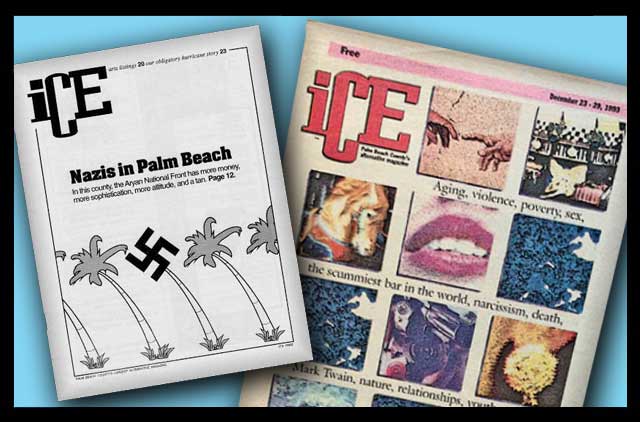
In 1992, while I was a reporter at the Sun Sentinel in South Florida, I started an alternative magazine without telling my editors. When they found out, they threatened to fire me – which, thanks to The Alligator, I was totally prepared to handle.
I quit my reporting job to run the fledgling magazine. But as the Columbia Journalism Review reported…
On the day he was to leave, July 29, the two sides reached an understanding. The Sun-Sentinel agreed to buy the paper; Koretzky would keep editorial control and have the right not to wear socks to work, as his agreement with the company explicitly states.
Now that I was a publisher, I got to hire people. So I returned to UF to interview for interns and job prospects. Of course, I visited The Alligator. I saw Mr. Barber in the same hallway where we last didn’t speak.
He smiled, said hello, shook my hand, and asked how I was doing. He already knew I was running a small start-up publication, and we talked mostly about mundane distribution issues: How to assure contractors didn’t dump papers, whether to buy new outdoor racks or refurbished ones, and how to properly assess return rates to tweak press runs.
Mr. Barber was more animated than I’d ever seen him. Then it hit me: Finally, he could talk about his day job with an Alligator alum who appreciated the boring nuances of it. No Alligator editor understands that. Nor wants to.
We parted with another handshake, and he invited me to call him if I had any publishing questions. I said I would, and I know I did at least once, maybe twice. But in my 13 months as publisher, I’m pretty sure I learned more than Mr. Barber already knew.
I’m not saying I was smarter than Mr. Barber. Just better trained. While the Sun Sentinel wasn’t known for its award-winning reporting, it was still a Tribune paper. Back then, that translated into: We make more money than journalism.
Indeed, if there was a Pulitzer Prize for selling ads and distributing papers, the Sun Sentinel would’ve won every year. So I learned from the best – something Barber couldn’t do trapped in a 9-to-5 in a small town. This was pre-Internet, after all. He couldn’t Google “How to sell more ads.”
Of course, he could’ve attended conferences and subscribed to newsletters. But Mr. Barber was a mellow dude. He had to be. Otherwise, he would’ve strangled bratty assholes like me and Brad Liston.
While this doesn’t excuse Mr. Barber’s business complacency, it does explain David Dahl’s scathing letter. What made Barber a living legend also made him a financial liability the longer he led The Alligator.
Whenever I had to make business decisions in my own career, I thought about Mr. Barber. I never really asked myself, “What would Barber do?” I realized whatever that was, it wouldn’t be enough.
Instead, I’d ask myself, “How would Barber do this?” Because that was usually the right answer: Smile, speak calmly, and don’t let the bastards get you down.
Silent treatment
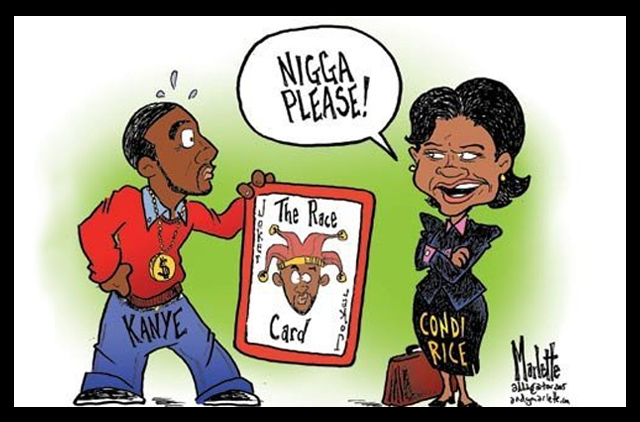
Mr. Barber resigned in 2007. Two years earlier, he managed his last controversy: The Alligator was accused of racism over a political cartoon. As Inside Higher Ed reported…
When Kanye West blasted President Bush’s treatment of poor black people in New Orleans after Katrina hit, the rapper unintentionally set off a hurricane of words in Florida.
The Independent Florida Alligator, the student newspaper, ran a cartoon last week that criticized West’s statements by showing him holding a large playing card marked “The Race Card,” and having Condoleezza Rice, the secretary of state, exclaim with scorn at West: “Nigga Please!” Since the cartoon ran, there have been multiple rallies against the student newspaper, with the latest drawing several hundred on Monday; the president of the university and other senior officials have condemned the cartoon and called on the paper to apologize for it; and there have been reports that students reading the paper on campus have had other students come up and grab the paper away from them, saying that it is racist.
Like many Alligator alumni, I followed this controversy with a sense of pride and a flood of long-forgotten memories of my own time in the newsroom. Unlike those other alumni, I thought mostly about Mr. Barber, who was (as usual) not quoted or cited in any of the coverage.
The controversy faded quicker than I expected. Mr. Barber didn’t urge the firing of the cartoonist, he didn’t orchestrate the suspension the editor, he didn’t call a “building-wide meeting,” and he didn’t stop talking to any students.
When Mr. Barber resigned in January 2007 citing “health concerns,” The Gainesville Sun cited only one example of The Alligator’s controversial past…
As the voice of UF students, the Alligator has seldom shied away from edgy topics, Barber said. And, at times, the paper’s judgment has been called into question. Such was the case in 2005, when an editorial cartoon depicted U.S. Secretary of State Condoleezza Rice uttering a racial slur. Black student organizations and some faculty protested, calling for a boycott of the newspaper.
Respecting a “firewall” between the business and editorial sides of the newspaper, Barber said he maintained his “hands-off” policy and didn’t interfere amid the debate about the cartoon.
Maybe Mr. Barber learned from the Disgusting Joke Contest. Or maybe, for once, times had changed and Mr. Barber changed with them.
Always Ed
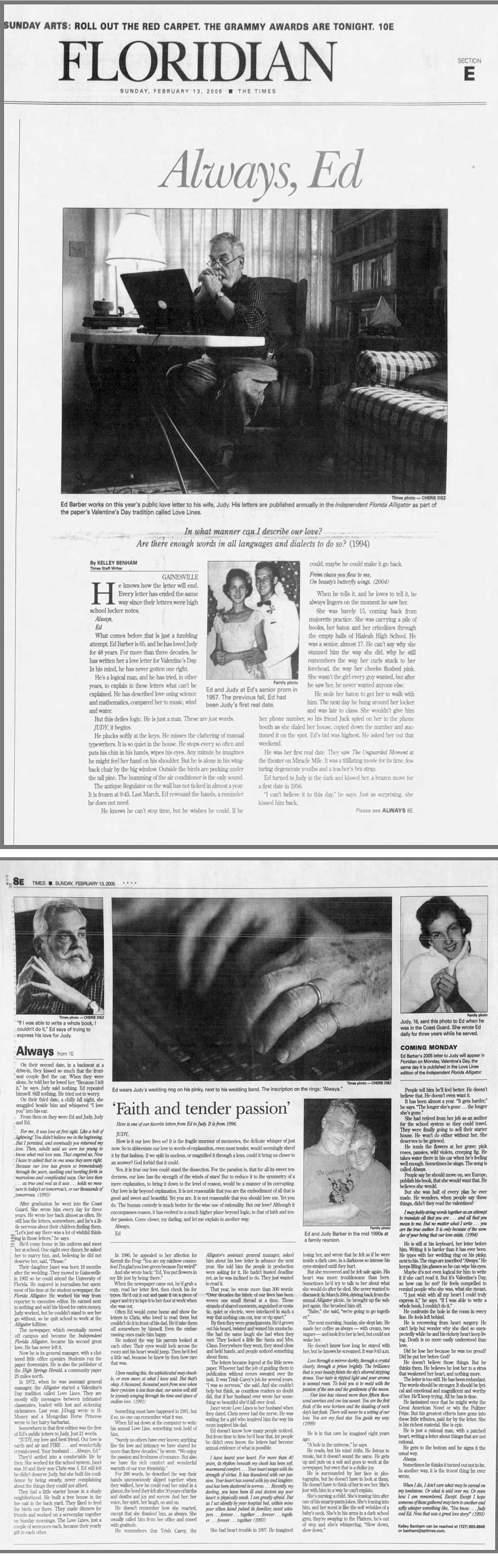
Six months before the “Nigga Please” controversy, the St. Petersburg Times wrote a story about Mr. Barber – actually, the story about Mr. Barber.
It was called “Always, Ed.” For some stupid reason, when the St. Pete Times morphed into the Tampa Times, the story disappeared from the paper’s archives.
I’ve uploaded scans of the actual pages that ran 13 years ago. Click the image above to read them. If you don’t feel like it, know this: It took up almost all of the feature section’s front page on a coveted Sunday, and it jumped to nearly an entire page inside.
The story described Mr. Barber’s annual ritual of writing a public love letter to his wife Judy – which The Alligator printed every Valentine’s Day starting in 1972. Alligator lore says that’s when the paper started a holiday tradition called Love Lines. Basically, it was a classified section for crass and/or syrupy declarations of love and/or horniness. During my time at The Alligator, I recalled several were apologies for cheating, followed by pleas to be taken back.
But Barber elevated Love Lines to its purest possible art form. As the story described, “The letters became legend at the little newspaper. Whoever had the job of guiding them to publication without errors sweated over the task.”
I imagine they sweated even more after Judy died, because Barber kept writing letters to her. As reporter Kelley Benham wrote…
Maybe it’s not even logical for him to write it if she can’t read it. But it’s Valentine’s Day, so how can he not? He feels compelled to remind who she was, what she meant.
If you don’t choke up a lot or a little when you read this story, you’re too much of a journalist.
When this story appeared, I was advising the student newspaper at Florida Atlantic University. I was also a member of the College Media Association, which maintains a hyperactive listserv for advisers to this day, even in the era of Slack, Signal, and Discord.
In 2010, in the middle of a typical listserv exchange, I mentioned I knew Ed Barber. The CMA president-elect at the time, who taught in Nebraska, replied…
Is that THE Ed Barber? The guy Kelley Benham wrote about in the St. Pete Times story, ‘Always, Ed?’ The story I insist my students read each semester about the Valentine’s Day love letters he wrote to his wife, even after her death? The story that always brings tears to my eyes and theirs – no matter how often we read it? The story reprinted in Harrower’s ‘Inside Reporting’ text? Wow, it would be an honor to get to know him, professionally if not personally.
Until that moment, I didn’t realize anyone outside of Florida knew who Ed Barber was. But once they knew I knew him, other CMA advisers quite literally asked me, “So what’s he like?”
The only Alligatoroid I still call a friend is the aforementioned Sonja Isger, so I asked if she realized Mr. Barber was essentially a legend. She was surprised I was surprised: “I’m one of his nearly bizillion fans on Facebook, and he gets all Ed-like there, too.”
How weird, I thought. I know a side of Mr. Barber no one believes, and another side only David Dahl documented. Yet I didn’t know the side of Mr. Barber everyone else does.
After The Alligator
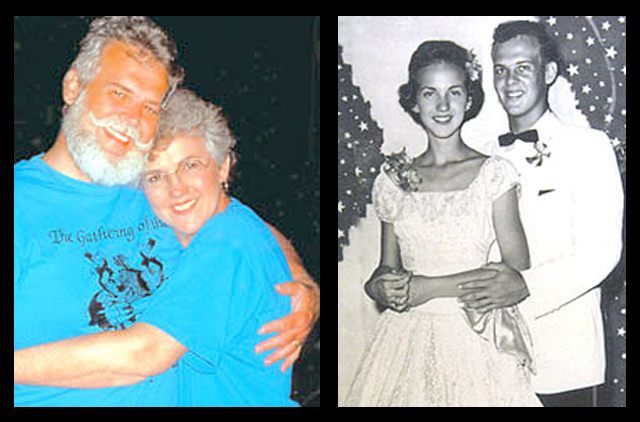
After the early ’90s, I never spoke with Barber again, but we emailed occasionally over the years. Somehow, he heard I got married in 1999, and he’d preface or close many of his emails by asking, “How is your lovely wife?”
Especially after his own wife died, that always choked me up.
I learned from Sonja Isger that Mr. Barber corresponded with many Alligator alumni, especially after his retirement. I often wondered if their exchanges was as scrappy as ours sometimes were.
“I just worried that some of your actions might violate laws, safety and set a bad example for the young staff who followed,” he once wrote me as we re-litigated the past. Another time…
In my opinion it wasn’t your dynamic journalism that was at any fault in my mind, it was the way sometimes you went about things that caused great concern and even potential harm.
I agreed with Barber that I wasn’t very mature or nuanced during my Alligator tenure. But to me, that’s the point of the place. The Alligator taught me how to grow up. More than once, I quoted Barber back to himself: “Remember, not all the lessons here are about journalism. Certainly not the most important ones.”
I also reminded him that nothing I did was actually harmful. I didn’t suspend the editor. He maneuvered the board to do that. I didn’t publish a political cartoon that led to “multiple rallies against the student newspaper.” My successors did.
Of course, these debates were always polite. I mean, it’s Mr. Barber.
Slowly, though, we started to bond – over a topic neither of us expected to. Namely, the ever-increasing blandness of The Alligator newsroom.
We both lamented: What happened to the feisty independent newspaper that once filed lawsuits like other people eat potato chips?
Remember, Mr. Barber had told The Gainesville Sun upon his retirement: “As the voice of UF students, the Alligator has seldom shied away from edgy topics.” Now it was just shy.
Mr. Barber emailed me a few times about “your fire in the belly” and how that fire was barely flickering these days.
One of the most controversial stories I had published during that Applause “semester from hell” was about gay bathroom sex. It documented how older men from as far away as Pinellas and Duval counties – more than an hour’s drive – hung out in campus bathrooms late at night, where they’d have unprotected sex with gay students who didn’t feel comfortable hooking up any other way. (Remember: Reagan ’80s.)
How did I know all this? I looked at the license plates on those cars and hung out in those bathrooms myself, where I conducted the most awkward interviews ever.
During the “building-wide meeting” over the Disgusting Joke Contest, this story was also cited as proof I should be fired. Barber said nothing publicly at the time, but decades later, he defended it in an email to me…
I had a great respect for your “fire in the belly.” I had no problem at all with your glory hole story. Why should anyone? It was a good one. So it shocked and embarrassed some people at UF. Officials knew of it yet didn’t stop it. That’s why there was such an embarrassment, although of course they didn’t say so.
It dawned on me that Barber never wanted The Alligator’s editors to be as pleasant and polite as he was. He felt most needed when his quiet charm could soften the rough edges of a controversy. And who doesn’t want to feel needed?
It now made sense why Barber wasn’t mad being banned from the newsroom that was in the middle of the building he managed. He preferred that to students he knew in his later years. He told me he thought often about why there were now so few oddball personalities to mentor…
There are at least five factors that have impacted The Alligator since you were here:
- Every year, UF has become harder to enter. It’s incredible how intellectually exclusive the student body has become. Are they too smart to work here?
- The student body has become increasing more conservative. Those leaning toward the left are less likely to accept any status quo.
- Many times when Alligator editors, reporters and shooters get really
good, The Gainesville Sun hires them away. - There are terrific opportunities for the top students for internships
with commercial newspapers and national magazines. That doesn’t leave much time for them to spend at The Alligator. - Just as there is great competition to get in, there is greater demand
put on students by UF. For example, it is much harder to take more than four years to graduate than it was in the past.
Maybe that’s why, in November 2007, Barber posted this on the CMA listserv, which I couldn’t imagine him admitting in the 1980s…
In addition, in having worked 41+ years with student editors (including Michael), I must say I always admired Michael’s energy, innovation and fire in the belly. In my opinion, he is one of two of the most dynamic student journalists we’ve had at The Alligator in the past 44 years.
I never asked him who the other student was. Now I’ll never know.
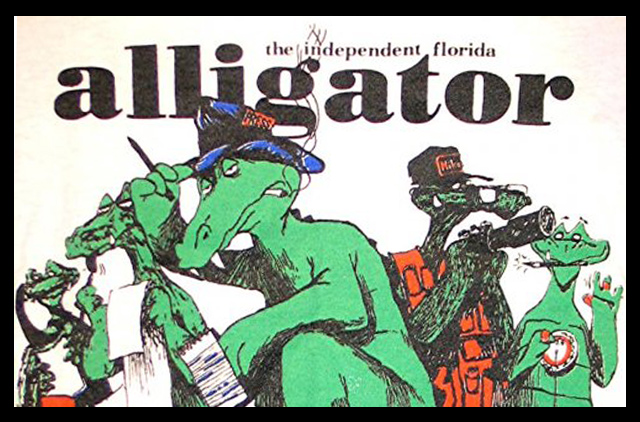
After Ed
In April 2016, I pulled The Alligator’s 990s and reported on its annual six-figure losses. Part of the discussion was about the inert alumni association, which Barber was supposed to launch after his retirement. (It was yet another project he kept promising when he was general manager.)
Mr. Barber emailed me, “I read your article and think it’s pretty accurate,” and he admitted he’d failed…
You’re right about trying to raise funds from among most of our alumni. I can’t even get many of them to respond to request for their current information for my contact program, but the association in my plan is to go far beyond getting money from individuals, although that’s being tried also. Many of your alumni work for organizations that fund non-profit entities. Some of them even serve on BODs of such. In that manner, they might influence a revenue stream for the Alligator without any outlay themselves.
That sounded familiar. Then I realized: He’s talking about getting grants from other organizations. I remembered David Dahl’s letter from three decades earlier. Nothing had changed.
Mr. Barber ended his email almost off-handedly…
One of the problems, Michael, is that I am the total staff and can only work part time. I’m also ill a lot: heart attacks, AFibs, diabetes, renal cancer, etc. … That’s why I volunteered to step down at the Alligator. I couldn’t give it the dedication I used to and it was unfair to the paper that I stay. I do miss it and the students every day, and will until I die. BTW, I have also been given an estimate as to how much longer I have to live, so I have to get busier.
I freaked out. I didn’t know what to say, and I don’t remember what I did. But Mr. Barber wouldn’t reveal anything else.
I asked Sonja Isger if everyone knew Mr. Barber was so sick. She said no, although she imagined the board of directors must know. I doubted that, since the board consists mostly students who, even back in Barber’s day, did as they were told.
So from then until this weekend, I held my breath with every email and Facebook notification from The Alligator’s alumni association. I’m relieved it took a decade.
One of Mr. Barber’s last emails asked, “Don’t you think it’s about time you started calling me ‘Ed’?” I told him I couldn’t do that. I still can’t. I never will.
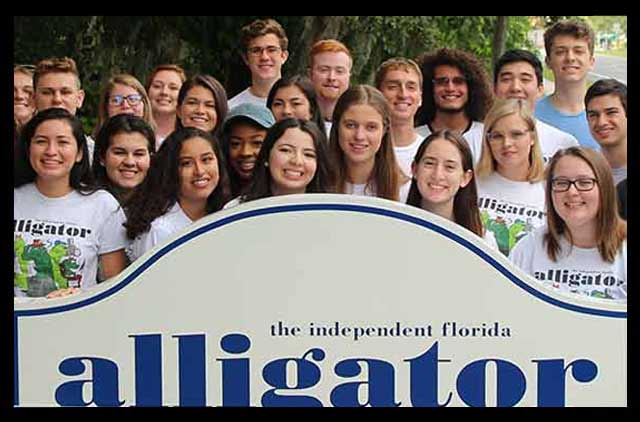
Not far behind
Mr. Barber led The Alligator for 30 years. I don’t see how the paper survives another 30.
His hand-picked successor was Patricia Carey – The Alligator’s advertising director when I was editor. She’s the one who broke into the Applause office and stole our answering machine.
Thankfully, she didn’t do anything like that in her 12 years as GM. Then again, The Alligator hasn’t really done anything controversial since before Barber retired. So maybe she would’ve.
Sadly and honorably, Carey was very much like Mr. Barber: polite, personable, and loyal to The Alligator when she could’ve easily earned more elsewhere. She was also hyper-traditional, incurious about the latest trends in publishing, and shy about cultivating business connections. (I talked to her at conventions and emailed her, that’s how.)
Carey resigned in 2019. Her replacement was Shaun O’Connor – The Alligator’s assistant general manager. He’s tried new things neither of his predecessors ever would: a joint issue with the University of Georgia for their football rivalry, broadcasting news meetings on Twitch, reviving the long-dormant Alligator alumni association.
Back when technology meant the moving the newsroom from manual to electric typewriters – another Mr. Barber initiative that never happened – you didn’t necessarily need to innovate or network or experiment. For a paper now losing six figures a year, you either do that or you die.
O’Connor is the anti-Barber. Thank God.
Because Mr. Barber will be properly venerated now and forever, no one will speak the truth to The Alligator the way it speaks truth to others: We need to honor Mr. Barber, but we desperately need to stop copying him. This is a newspaper, not a museum. It could easily end up as a mausoleum.
Mr. Barber kept The Alligator alive while he was. When he got sick, it did too. When he died, The Alligator probably received its own death sentence. It just doesn’t know it yet. If we can keep it alive, it won’t be because of Mr. Barber. It’ll be because we moved on from him. And I truly believe he’d want it that way.
 journoterrorist