Want to freak out a newsroom full of college journalists?
Sit them down at manual typewriters and ask them to plunk “2011” onto a piece of paper.
They’ll only make it halfway.
“Mine’s broken!” one reporter at Florida Atlantic University yelled a couple of Saturdays ago, when we launched the inaugural ALL ON PAPER project.
“There’s no number 1 key.”
“This one is busted, too!” yelled another.
“They’re not broken,” I replied. “Manual typewriters didn’t have a number 1 key. They used a lower-case L instead.”
“Seriously?” asked the first reporter. (Seriously. Click the photo below and look at the top row of keys.)
“That’s totally fucked up!” declared the second. Those same words have been repeated often these past two-and-a-half weeks, as we’ve embraced pre-computer technology to publish the last summer issue of FAU’s student newspaper, the University Press.
Some pessimists predicted ALL ON PAPER would be an exercise in futility. It’s proven to be a lesson in humility – for both the student journalists struggling with the old tech for the first time, and for the veteran journalists trying to recall how it all worked a few decades ago.
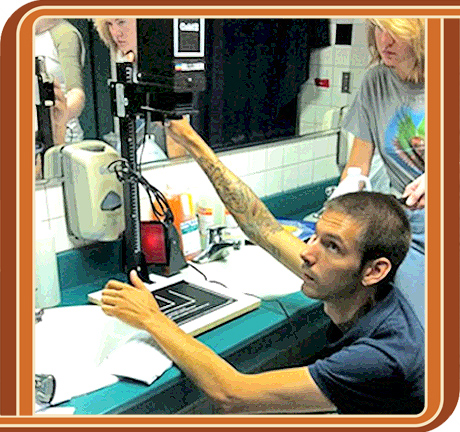
“Man, I forgot how much I forgot,” pro photographer Mike Rice whispered to me as he advised the photo students on how to set up a darkroom (which he did in a men’s room – more on that later).
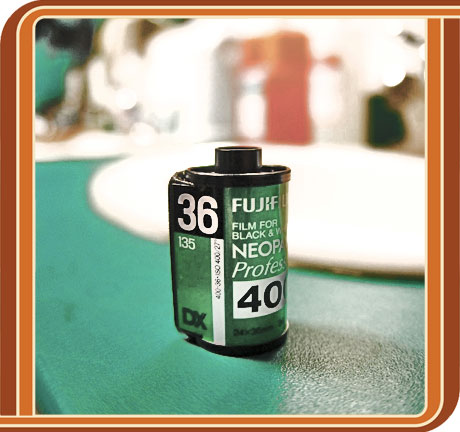
Rice had a ratty old textbook stashed in his camera bag, which he referred to furtively and often. After all, one wrong mixture of chemicals, or one processing step out of order, and a roll of 35-mm film or piece of light-sensitive paper comes out blank. And neither of those items come cheap. (Thank you, SPJ, for giving us a grant.)
I, too, had trouble: How many words in a column inch again? How did I use this stupid proportion wheel once upon a time? And is the copyediting symbol for abbreviating, not abbreviating, spelling out a number, and using a numeral really all the same thing?
(Yup, you just circle the AP-Style-offending word or numeral, and the typesetter knows what the hell that means.)
So screw the students, here’s what I learned from ALL ON PAPER…
While archeologists try to recreate what life was like 10,000 years ago, and historians try to recreate what life was like 1,000 years ago, journalists can’t even recreate how they published a newspaper 20 years ago. No one documented the details or saved the old equipment. (I had to buy some of it from creepy old men through Craigslist.)
Journalists may write history’s first draft, but when it comes to covering their own history, they don’t even take notes. I can imagine college students 20 years from now asking their aged adviser…
Your digital cameras didn’t just beam images to the cloud as you shot them? What’s a “memory card”? And you had different programs for writing, design, and photo editing? Does anyone still have “Word,” “InDesign,” and “Photoshop”? It’d be fun publishing an issue that way – maybe we can buy copies from some creepy old men on Craigslist.
But what about the FAU students? What exactly did they do? And what exactly did they learn? Well…
1. Writing and reporting
After blowing their little minds with the missing number 1 keys, I still had to show the students how to set the typewriter margins.
(They enjoyed playing stupid and asking me questions like, “Who’s Marge?” Huh? “MARG RELEASE!” At least, I hope they were playing.)
Managing editor Mariam Aldhahi was stymied after typing her first line. “What do I do now?” she asked. “There’s no RETURN key.”
I pointed to the lever that would propel the carriage back to the left, while the gears inside would simultaneously ratchet the paper to the next line.
She tapped it lightly.
“No, this is a manual typewriter,” I told her. “You actually have to expend some calories.”
I slammed the lever to the right, and the carriage flew back to the left margin, stopping with a thud. A look of understanding, laced with horror, crossed her face.
“It’s going to be like this the entire time, isn’t it?”
“Not at all,” I said. “It gets worse.”
Worse was watching them edit their own stories.
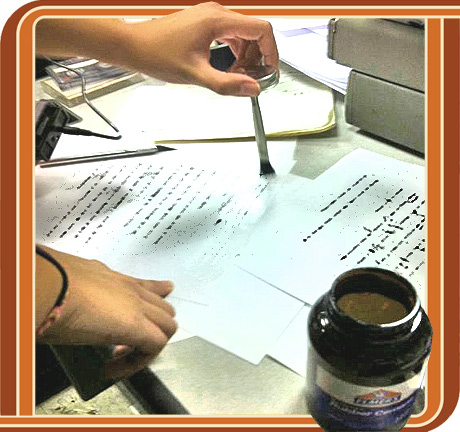
In the pre-computer days, the easiest way to juggle paragraphs wasn’t retyping them – it was cutting them apart with an X-Acto blade and gluing them together in a different order.
This they did fairly well, after a comical and clumsy start. Mariam accidentally stabbed one of the reporters, but she didn’t draw blood. And no one tried to get high by huffing the rubber cement. (An improvement over my days at the University of Florida newspaper in the mid-’80s.)
One reporter, Mark Gibson, claims he got more done and had more fun using the old tech…
Technology, with all its advances in communication, keeps us further apart. Not being able to use email or cellphones forced us to be together in the newsroom every day. It was awesome having everyone there working together, and I felt like we accomplished more.
…and I don’t think he was huffing when he said it.
2. Shooting and processing
At least the writers wrestled with their typewriters in the newsroom. Photo editor Christine Capozziello spent two Saturdays in a little-used Student Union men’s room with Mike Rice.
Christine and Mike decided it was the only space big enough and dark enough – and with electricity and running water – to double as a darkroom. So they slapped an OUT OF ORDER sign on the door, duct-taped a red safelight to a urinal divider, and sat on the sticky floor making prints.
I thought it was gross, but Christine says it was “honestly pretty cool.”
“After a while I forgot I was even in a men’s bathroom,” she says. “I was just so preoccupied with developing the photos.” She learned a lot, and not just what a urinal cake is…
Having a hand in each step of the process was much more rewarding than instant digital photography. It feels much more like an art that way, which I loved.
3. Editing and copyediting
Just like the reporters have learned that “cut and paste” once involved actually cutting and pasting, the copyeditors have learned that the copydesk was once a real desk.
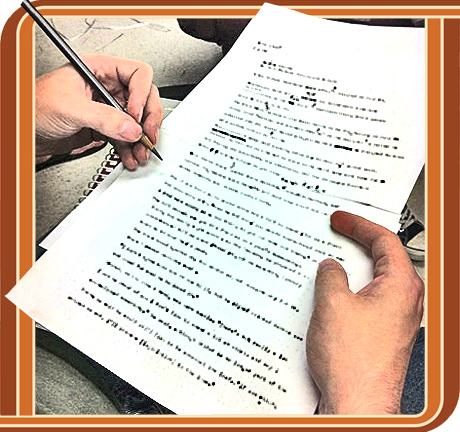
Our three copyeditors huddled in a corner of the newsroom, marking up stories with Ebony pencils and using copyediting symbols they learned from a cheat sheet consisting of carets, lines, brackets, and squiggles.
“Not having computers to verify the spelling of students’ names was the most inconvenient part,” copydesk chief Brandon Ballenger says. But there were advantages…
Showing the writers their heavily marked-up copy was more gratifying than sending back a digital doc with largely invisible changes – and hopefully it teaches them to write with more care.
4. Designing and sizing
Mariam, our managing editor, was previously our rock-star art director. So she resumed that role for ALL ON PAPER. Her designers mostly deserted her after they learned a terrifying reality of pre-computer layout…
You must do math.
First, there’s headline counting: A capital M is two, but a lower-case L (or is that the number 1?) is one-half. So how many counts do I have for a 48-point head across two columns?
Then there are the stories whose column inches must be distributed evenly across the page, requiring long division (without a calculator) and resulting in vaguely sexual newsroom directives like, “I need 11 inches to fill this box, and I need it now.”
Finally, there’s sizing photos with that confounded proportion wheel. Even though it’s supposed to help you shrink or enlarge a photo, and even though the instructions are printed right on the front, that God-awful wheel still doesn’t ever seem to give you the proper percentages. It’s more like a Magic 8-Ball than a round slide rule: much more mysterious than accurate.
“It’s been rough,” Mariam admits. “I’ve found myself sitting in silence, reminiscing about the days when CNTRL+Z was all it took. I miss my iMac.” But she also confesses…
Regardless of the stress or the obscene amount of paper that’s accumulated on the newsroom floor, I won’t forget what this project has given us. We’ve formed this sort of newsroom camaraderie that I hadn’t experienced before, and it means everything.
5. Typesetting and pasting up
The loudest “That’s totally fucked up!” came when the students learned everything they wrote on typewriters and edited in pencil would indeed be keyed into a computer.
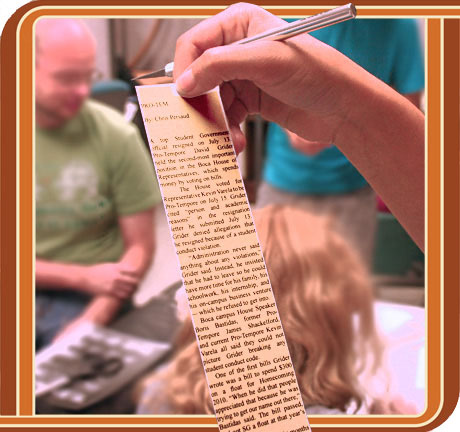
Of course, at the dawn of the pagination era, that computer was a typesetting terminal filling up half a room and spitting out stories in long columns that had to be cut out and pasted up.
To mimic an ’80s-era Varityper, we set up a single iMac, keyed in all the stories in single columns, and ran them out on a laser printer. Then the paste-up artists trimmed and glued them to larger pieces of paper.
(In the old days, these “galleys” were run through a hot waxer. But not even the creepy old Craigslist guys had one for sale. So we used more rubber cement.)
The editors had the nifty idea of compelling the writers to paste up their own pages. That didn’t survive the first week. Many staffers learned that, while they can deftly manipulate a mouse to kill hundreds of bad guys in a videogame, few of them can draw a straight line. So Mariam and editor-in-chief Gideon Grudo did most of the paste-up.
Concluded Gideon…
After looking at a finished page – a page that took us half a day to finish – we felt so content and satisfied. I’ll compare it to the difference between buying a McNugget and hunting down your own chicken, gutting it, deboning it, and cutting it into nuggets.
Doing ALL ON PAPER all by yourself
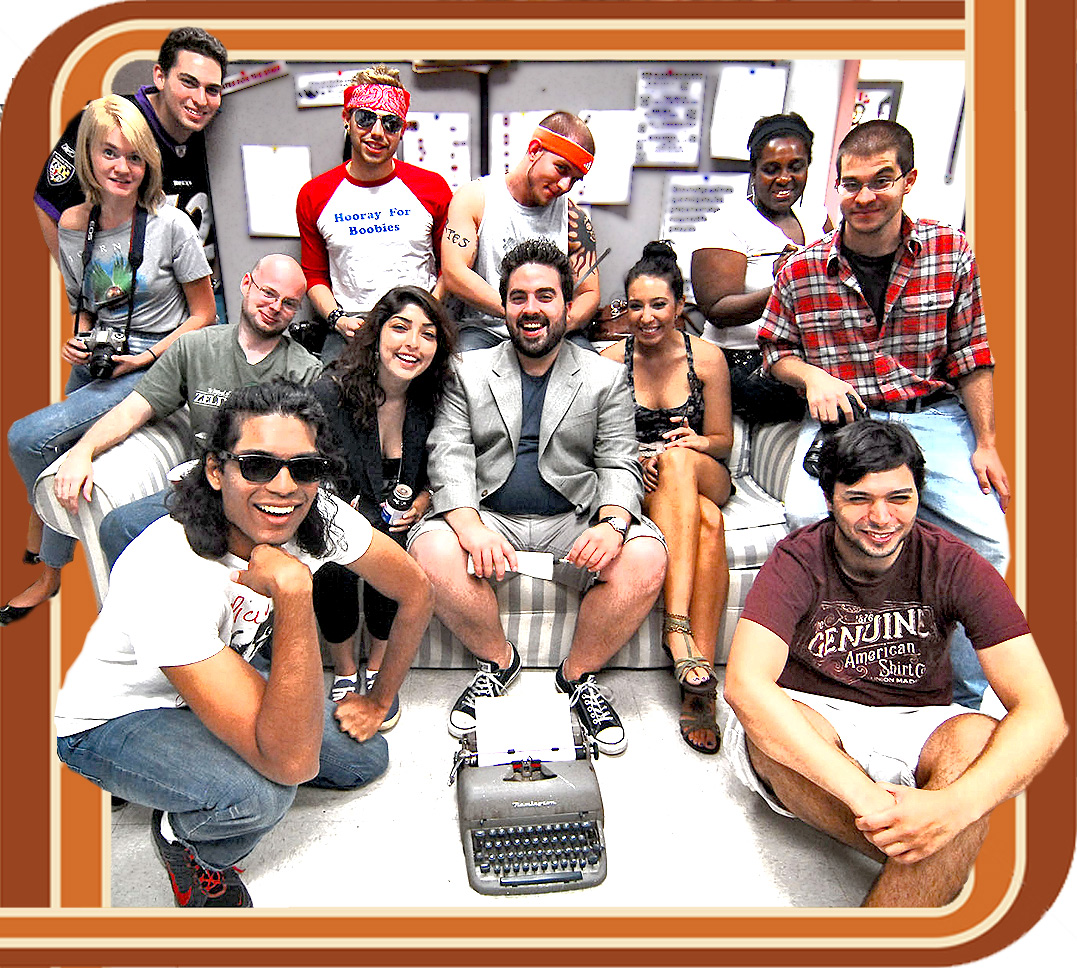
If these students can do it, so can you. We still have the ancient equipment, and we didn’t use up all the pricey supplies. So if you want to try ALL ON PAPER – we suggest a four-page pullout rather than an entire issue – email journoterrorist@gmail.com for details.
Wondering how the issue looks? And how it reads? Click either cover…
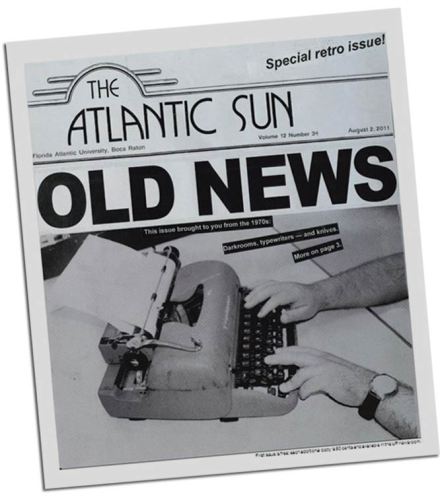
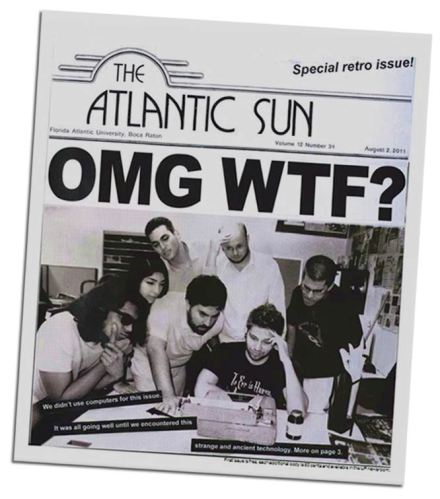
…And if you read the previous ALL ON PAPER post, you might be wondering: Which cover did the student choose? Answer: Both.
At their request, I called the printer, and because this is an entirely black-and-white issue, he didn’t charge us for splitting the cover – half the press-run was “OLD NEWS,” the other half was “OMG WTF?”
If you want to see and hear what ALL ON PAPER was like, here are two outside takes. The first is from videographer Tatiana Cohen…
Then there’s this you-are-there slideshow from radio reporter Pam Geiser…
Finally, I’ll end with this weird but inspirational quote from FAU staffer Chris Persaud…
Technology hasn’t made us lazier, but it has made it possible to be lazier while still producing the same amount of quality work. Now that I’ve realized this, I know I’ll definitely be working faster to produce more quality news. And unlike the ancient civilizations of the 20th century, I’ve got the technology to do it.


Hey FAU! See how it was done back in the day as photoed by one of our former profs:
http://commfaculty.fullerton.edu/woverbeck/dtr5.htm
Check out the clothes as well as the machinery.
Great idea to do this. Hope it catches on. Love the slideshow.
Re the first video: what the hell is going on at 2:26? Who’s cheating and using an iphone right in front of the typewriter? Looks like they’re FBing (2:31) when they should be typing. Can’t leave FB alone for one day, eh? An indictment of an entire generation summed up in five seconds.
Very cool project! I was a first year university student in 2000 – I used to take all my research notes on a jotter pad, write my drafts up by hand, and then book time at the computer lab so I could type up the final version. Hard to believe now…
I in my mind arrive at the Burbank Daily Review at 7 a.m. any weekday morning between 1960 and 1967. I hear the wham bang of the teletype, smell the paper.
On my big wood desk, I can see the 8 ½ by 11 dummy sheet on which I lay out the “Burbank Families” page. We drew it on paper then, didn’t paste. I didn’t use a proportion tool, I could tell by glance how it would work.
At 7.m., that page would have the outline of what was going to be published today already there. (All these years later, I dream that it is totally blank.) What copy today? Go through the piles of paper. Can I finish that story? That feature? There is a proof of something I wrote yesterday.
The typewriter. I think it was a royal. There was a big roll of paper attached to wire under the stand. It was double sided for an automatic carbon.
Check with the photog. Did you get that picture of the Woman’s Club. What kind of feature might there be from the AP?
I was a one-woman band then. I did it all myself. I came to work in a skirt, hose and kept a hat and gloves handy.
Write, re-write, cut and paste. Big bottle of rubber cement. Pencil to mark it up; I still use those symbols when I proof my output.
Pictures? Need actual size, black and white, contrast is good. Action is good. We had just replaced engraved ‘cuts” with a machine that etched the image into a curved piece of plastic. It crackles and whirs.
Balance the page. Light and dark. Nothing wrong with white space. Something heavy like a head or a picture. Make sure larger type heads are up and smaller ones down . Sometimes something like a slightly larger head or a picture at the bottom to “anchor” the page.
Write the heads. Count them out to fit. Another thing that became intuitive when I did it every single day. Few choices for type . I liked Bodoni and Goudy. Light, airy, but with some authority.
Put each piece on the “nail” for the print shop.
First deadline: 8:30 a.m. That’s for me. Not being timely news it can be set up earlier. Finish up by running out to the print shop. I stand by the linotype chatting with “Freddie” ( a woman operator, my God) The slug falls into the slot with a clunk. She catches a typo for me. Sisterhood was beginning to happen.
I stand by the compositor and answer questions as he finishes putting the type into the metal frame for my page. Yes it was broadsheet size. I do need to make a couple of cuts. I wrote “upside down” so it could easily be cut from the bottom.
Tighten everything up; send the metal chase to the press room to be cast into a round lead cylinder.
The final deadline for the entire afternoon paper was noon. We were pretty responsive then. The JFK shot special? We held it up a little while, but it was out that day.
The rest of the day till 3:30 p.m. is tomorrow’s page. Calls, “covering” meetings and events in person. Taking some pictures. (A speed graphic at first. Then it was somewhat smaller.) Editing. Lunch at Woolworth’s.
I did this five days a week (I prepared ahead for Saturday, but would often drop by just to make sure.) It was my responsibility. I guess “for a woman” (yes they said that then) I was paid pretty well. I don’t remember the exact amount but I paid a baby sitter, bought groceries, a new washer and dryer. The job had a demand for fairly nice clothes. Had a home. Sent my first husband to college.
Now in 2011 with the help of Dreamweaver, Photoshop, Flash, html5 and css3 I am learning to design better web pages! (Same principals: balance, light and dark, white space.)–Betty (Pardieck) Graff.
Remember film? Remember when “cut and paste” actually involved scissors and glue? Remember when typewriters didn’t have a 1 key? Probably not, right? I’m old and I barely even remember that stuff. […]
Wow, thanks for hammering home exactly what an ancient dinosaur I am : )
I’ve still got my pica pole, proportion wheel and a pneumatic capsule from the in-house messaging system, used to ferry page layout mockups from the newsroom to the composing room.
I still use copy-editing marks on printouts in my office, so the staff is literate in that craft, at least.
Good project!
In the olden days, we didn’t use knives to juggle paragraphs — too slow, and in any case, knives were for the composing room. We used a straightedge and ripped, just as we ripped copy off the wire machines.
Typewriters were already anachronistic when I got my first newspaper job at a small weekly in 1981. I had an East German model, bought secondhand somewhere. By the time I left two years later the daily finger workout had given me the hands of a gorilla. When stories were done, the editors actually rolled up the copy, put rubber bands around the ends, and dropped them down a tube to the basement, where a typesetter with unbelievably nimble fingers would type them into a piano-sized computer. Reporters pasted up their own copy. But those analog days ended already with my next job, where they had a word processing system that, though primitive by today’s standards, seemed like a quantum leap. It’s fun to reminisce about, but I can’t say I miss it.
[…] de periodismo a hacer un diario como se hacía 20 años atrás. Es decir, sin ayuda digital. El resultado es un largo post que recomiendo leer, dos diarios (abajo está uno) y estos dos videos que comparto con […]
Hey everyone, I’m Chris Persaud, the guy who got stabbed by Mariam. Our website is http://www.upressonline.com.
You can check out our new old issue right there!
Thanks for the trip down memory lane! I was a computer programmer for 45 years, but I wrote, edited and did the paste-up of many a newsletter for non-profits and as a freelance newsletter guru for a number of small companies. Won a few awards, including beating out my then-employer’s newsletter for an Addie. LOL I thought I was in heaven when Wordstar and daisy wheel printers became available for printing out columns of text.
[…] out the entire article here. It’s some funny […]
[…] out the entire article here. It’s some funny […]
What a fantastic project. I definitely agree with the sentiment that newsrooms were a lot more fun when putting the paper together was actually tactile. I think we’ve lost something in the digital revolution.
Creepy old men preserve the history the academy does not privilege – at least not until it’s too late.
Thank creepy old working class men for obsolete tools. Creepy old Black men for blues and jazz. Creepy old gay men for most other kinds of music and most pop culture. Creepy old Jewish men for any kind of ephemeral machine age knowledge.
It is their privilege, but our legacy. Cherish it and them.
[…] […]
If you listen when the US President speaks at his lectern, you can still hear typewriters being used by professional and respected journalists in the background.
I think as I age, especially as I age out of the workforce, being only nominally proficient with a computer, I will simply hang out a shingle that says, ‘Analogue Repairs’.
But only on days when I’m bored.
Great stuff, folks. Beat-up Macs were the typewriters of the era when I broke in in 1995, but our student paper still used the waxer and my first internship was with a paper that still did its own paste-up in the back. The production guys were feared by all in the newsroom. And I had my own darkroom in a bathroom too, for a while…
Interesting article and a neat project in seeing, or remembering how things were done. My only fault is with the writer of this article, how old are you, 12? How many times in one article can you reuse the phrase “creepy old Craigslist guys”? It became tiresome very quickly and one can bet that while dealing with these people you were smiling and nice to their face, just insulting once you got what you wanted.
Publishing even a weekly paper was like having a baby 52 times a year, so why do I miss all that? I guess because it was so very hard and took so much effort and commitment…that’s what I’m missing. Thanks for the article.
I’m surprised they made it past the zero in 2011. Every non-electric typewriter I’ve seen required using uppercase-O for zero (as well as lowercase-L for one).
Awesome!!!!! Still I would not leave my mac😛
Oh gods, I used to love the smell of the hot waxer.
I got a job as a staff photographer at the age of 16 back in 1990-91. So many of the computer systems were already in place, but the paste-up table was still there and the newspaper didn’t start going digital for another 4 years. My job interview came down to me handing the chief photographer an Ilford box full of 5x7s and eventually he made sure I could roll film on steel reels. (Believe me, it takes some practice to do it right.)
I didn’t even know you could still buy film, and where did you find cameras that use film?
They’re not that hard to find. The Nikon F2s and F3s from the 80’s era were tough and all but ubiquitous at the time and not hard to find now.
Interesting and great fun. It would have been more interesting if you’d gone back just a little further, to the 60s, say. When I entered the news business in 1969, it was the same manual typewriter and gluepot, but photos had to be engraved onto metal plates (on a machine named Hell) for printing and type was set in hot lead on a linotype machine.
All the lead and metal for a page, type, art, ads, etc., were placed in a frame called a matrix, an impression taken and that impression transferred to a lead plate that went on the press. So the original matrix is a mirror image of the page, the impression is a positive, the press plate is another negative and the final printed page is, of course, positive.
I also noticed you said nothing about converting your hard-won photos to halftones, which was a lot of fun (gaaah!) in the 80s, using the proportion wheel and a stat camera, basically taking a picture of the picture through a screen to turn it into dots.
You really did it the easy way. Not that you could have gotten a linotype or a stat camera, much less a hot-metal press or a plate-making setup. Oh well.
By 1975, we were using electric typewriters and an OCR scanner and editing on CRT terminals, which fed type to a phototypesetter. And by 1980 every desk had a computer terminal, copy was edited on screen and pages were built on screen. There was almost no one left in the composing room.
You know another thing you didn’t get with the old tech? The chance for loads of people to pile in on the published account of your project, and instead of praising how you coped with equipment and skills you couldn’t be expected to have been exposed to in the normal course of your studies, they decide to carp on and decry your writing style or suggest being spotted using the phone is “An indictment of an entire generation summed up in five seconds”. Well, they could do that twenty years ago – but I guess they would have written their churlish letters in green ink and you could have opted to just stick them straight in the bin where they belong instead of publishing them. Great project, well done to all for both carrying it out and being so public about it. I wish you all the best in your careers in an industry that desperately needs to be looking forward to a digital future to survive.
The typosphere is eating this up. Great project!
When I received my journalism degree in 1982 computers were very new. I did all these things. Sure makes people more thankful for what they have today!!
As someone who started out in the (electric) typewriter and literal cut-and-paste era, I still can’t figure out why all you people are so nostalgic about it. It was cumbersome and clunky, and good riddance.
On my first newspaper job in 1969 at the Albany Knickerbocker News wedding announcements were a big deal. We were still using lead type and I went down to the layout room to make sure that all the bridal portraits were facing into the middle of the page. (The women’s editor said we didn’t want them to look like they were staring out into space.) If too many brides had portraits taken the same direction some would wait weeks for their announcement to appear. Once in a while we flipped a photo (the metal platemaker didn’t care) but the bride’s mom knew on which side her daughter parted her hair and we’d get busted. Now, as an antiquarian bookseller, I write my own catalogues on a computer but I proof them with a pencil on the printout. Then make the corrections on the Mac. And, yes, I still use those symbols. Also in notes to myself I use the city abbreviations that we used at the AP (CX-Chicago, WX-Washington, etc.) The AP bureau chief said he hired me principally because I typed faster than any reporter he’d ever seen.
Linda Lebsack
Student journalists at Florida Atlantic University used such 20th-century tools as manual typewriters, a photo darkroom, X-Acto knives, and proportion wheels to assemble The Atlantic Sun, the final summer issue of the campus newspaper, the University Press. Journoterrorist has the scoop, and Tatiana Cohen captured the whole process on video. […]
All this is about MODERN technology, compared to when I started newspapering in the 1960s and there were linotype machines and raised metal type and stonehands to put it into forms, sometimes using clippers to cut a line (you could only do it at the end of a sentence). And what about the lost art of reading raised type upside down and backwards? That’s one of my talents I don’t expect to use again.
20 years ago? We did have electric typewriters 20 years ago. Really. And calculators. Heck, 30-some years ago — in Florida — working on a student paper, I may have been the only student around who had even seen a manual typewriter without a “1” key.
Was that a can of WD40 next to that typewriter? FYI – there’s almost nothing on earth that’ll gum up a typewriter’s works faster than using WD40. It might make it work smoother for a very short time, but then the liquid evaporates and you have a gunky mess in the mechanics.
Best is to try and just keep it clean and oil free. If you absolutely need to, use gun oil or sewing machine oil.
Starting at the local daily (Pine Bluff Commercial) as a copy editor when it still used hot type, and progressing to news editor after computers came in, it’s nice to see a younger generation getting some hands-on experience with the old tools. And it’s refreshing to find others who stilll have ink in their veins, if not on their sleeves. Kudos from Clinton country. — D. H. Ridgway
How incredibly upscale. Paste-up? 35 mm? What about Linotype, Ludlow, Speed Graphic, copy spikes and payphone dictation to rewrite? I do not, however, miss the smell of hot lead and whiskey in the morning. When I first started as a courthouse reporter at the American-Statesman in the late ’60s, I noticed a dent in the back of my upright Royal. The story was that a deranged vet (PTSD, for those who need a contemporary translation) ran into the newsroom and sprayed the place with a .25 automatic pistol. The dent was a reminder. Regardless of the story’s voracity, consider whether your Mac will protect you from gunfire.
[…] HOW TO BUILD A NEWSROOM TIME MACHINE « journoterrorist (tags: toread news media) […]
You should actually be thankful you didn’t find a hot-wax machine. You would have had to go with rubber cement anyway. I vividly recall trying to paste up some material created with the adorable little Macintosh and the uber-cool laser printer, and having it fall right off my paste-up sheet. The wax soaks right through the laser bond; there’s not enough left to stick. It was designed for, and worked so well with, the wax-resistant photosensitive paper that ran through the Compugraphic typesetter.
Frank and C. Murray:
In reply to your criticism of my criticism of “creepy old men” on Craiglist…
First, I agree with Frank that old men should be cherished. They speak uncomfortable truths loudly and lustily, since they don’t give a shit about their social standing — because society affords them none. So they have nothing to lose.
Second, I’m not ageist, because I’m quickly approaching “creepy old man” status myself. In a newsroom of college journalists, I hit that mark at 35. (Although my students use the related term, “bitter old man.”)
But I’m serious here: These were some creepy old men on Craigslist.
I bought one manual typewriter from a guy who emailed me to stand outside the gate of his overgrown lot, ringed by a rusty chain-link fence with four BAD DOG signs hanging at weird angles. I yelled “Hello?!” and a scrawny old guy in an open bathrobe, striped boxers, and pink flip-flops emerged from a side door. He handed me the typewriter case and a receipt, stuck out his hand for the cash, then disappeared inside without saying a word. He never made eye contact, and he smelled like grape bubblegum.
I find that a tad creepy.
I won’t describe in detail the guy who sold me another typewriter from his dead mother’s apartment and walked around the place pointing to items and asking if I’d give him $20 for them.
Certainly, not all old men are creepy. And not all creeps are old. But in this one project, those two qualities merged.
— Koretzky
I used to use equipment not a lot more advanced than this back in 1990 or so when I worked at Avon Wildlife Trust and we produced a wildlife magazine once a month AND a children’s version too once a month. There were two of us doing illustration (with pens) and design and paste-up.
I really miss it.
Oh gosh! I’m 26, and learned how to develop film in high school (we had our own blackroom. Actually, I think my high school still teaches it). I always found developing film to be more rewarding than digital. Something about the texture of pictures and the fact you don’t know how it’s going to turn out until it’s done.
I also remember playing on my grandfather’s typewriter; I started to learn how to type on it, even though I was mostly taught on a computer keyboard. (I even remember pre-dial-up internet days!). Anyways, it’s good to see efforts to keep these skills alive. Never know when it might become handy, and it’s definitely a good exercise for younger students.
[…] HOW TO BUILD A NEWSROOM TIME MACHINE « journoterrorist So screw the students, here’s what I learned from ALL ON PAPER… […]
This is excellent. To be fair, at 41 I’m not sure I’d remember how to do it the old-fashioned way anymore. Brilliant idea.
In the UK rubber cement is universally known as Copydex, the leading (and possibly only) brand here. Until reading this article I never realised the name was a play on ‘copydesk’ and ‘latex’.
I published a weekly paper for 10 years, from 1987 to 1997, using plain paper from a laser printer and a waxer and never had a problem with pasteup. Either you were using the wrong wax, or it was way too hot.
I used to do all my writing on an Adler manual typewriter. That sounds a bit grand, so here’s some context. I was a ten-year old; we had a bunch of manual typewriters knocking around in various offices. […]
This could be a neat exercise if broadened to the digital music editors of today. Remember splicing tape?
I loved reading about this and commend the students for their hard work & positive attitudes about it. That these tools were used daily at one (relatively recent) time does not take away from the fact that so much has changed since then. I was surprised by the 2 f-bombs though😉
(*cough*)
That’s “Varityper”, not “Verityper”.
– tnh@panix.com
[…] In 1997, it was time to publish my PhD. thesis (100 plus pages and well over 100 formulas), I found a typist in NYC who would charge $1.00 per page plus $1.00 per formula. […]
You should have used a Remington Ten-Forty typewriter. I’ve just dug mine out of its hiding place and I can confirm it’s got a full set of number keys.
[…] off to former Sun-Times colleague Howard Wolinsky for this great post at journoterrorist — I actually began my journalism career in this world. Wouldn’t quite want to go back […]
What a great project, but it makes me feel so ancient. Anyone remember Cow Gum?
I worked on a regional newspaper in the UK until about 18 years ago and we did pretty much everything you describe. Then one Monday morning we got into the office to find our Remingtons had been replaced with Macs. We also had a new photocopier, fax and switchboard.
No-one thought it necessary to give anyone any training on any of the new equipment. It was complete chaos for a few days until we worked out how to use it. The editor refused to use his new computer for anything other than word processing and would not connect to the internet on principle.
I’m glad we’ve moved on, I didn’t care for those long press days and hanging round the typesetters while they did all the corrections, making sure they didn’t do single line corrections (those tiny bits of waxed paper had little or no adhesion and easily fell off the pages on the way to the plate maker). Now it can all be done in a few keystrokes.
I do wish my great grandfather, who was a hot metal compositor, could see how things are done now.
Teresa Nielsen Hayden:
Thanks for the copyedit, always appreciated. “Varityper” is now spelled correctly.
Hope that cough improves.
— Koretzky
Woah! I love this post, this idea, & the students amazing effort to use old tech! I remember messing around with my mom’s old typewriter back when i was little; i was memorized by the thing! Technology has change SOOO much over the past years; hardly remember what it was like before every single person had cellphones.
I would love to have the opportunity to learn how to develop my own film the right way. I got stuck doing the project in 10th grade, but my teacher was clueless on the subject and all my film didn’t turn out. I was so disappointed.
But, kudos to the students on a job well done!
Really, you should have mailed us this post to make it complete and true to it’s core….and then we would have mailed you our response and then 2 months from now the circle would have completely come around with our letters/comments to you in print.
bro
You need to get hold of that splendid piece of music made by typewriters.
Proportion wheel!! What about “what you want, divided by what you’ve got, times a hundred over one” or some such.
This is a fantastic project, thank you so much for taking the time and effort to learn and share these skills – and remind me of how much ‘upskilling’ I’ve done in my career.
At 47, I am now a digital content manager, graphic designer, production manager and digital photographer having started my working life as a junior ‘commercial artist’ in a printing factory at 17.
I’m now considering studying at Uni for the first time in my life. Perhaps I’m still working ‘upside down’…
[…] more in How to build a newsroom time machine at the endlessly entertaining […]
[…] How to build a newsroom time machine […]
No wax machines! God, was the last time I saw one only 12 years ago?
Nice project. Reminds me of drawers full of cards allowing you to find books in a library.
Intresting project .
The bullpen was always badly lit, and the little red eyes of cigarette coals glowed through the heavy smoke that drifted in layers from the ceiling to the floor. Phones ringing, typewriters clacking, pneumatic tubes thumped. Occasionally someone yelled, “Copy!”, but not much conversation. Five editions a day. We wrote a book five times a day.
I hope that any telephone calls made during this process were required to be done on dial-phones (I still have one).
Really, a neat read.
Brilliant, absolutely brilliant! I miss the old newsroom days. All of the shared agita in producing the paper, or in my case a show, made you understand why a giant bottle of TUMS and a bottle of jack were always in the editor’s bottom drawer!
Dancing in the dark…
Reading: “A Dance With Dragons”, “Smile or Die”. Web. What I’m Reading Finished A Dance With Dragons by George R. R. Martin, latest book in the Ice and Fire series. Enjoyed reading it quite a lot. I wasn’t that impressed with “A Feast for Crows…
Hmzzz, strange my Olivetti typewriter has a standard Querty keyboard. But hey on your side of the pond it seems to have lost it’s 1…….odd?
I’ve gone from hot lead to Facebook during my career. I would not have thought so much could have been learned from analogue journalism. Nicely done, folks.
I loved this but Proportional Tool! How lazy is that. I wonder did any of the reporters realise that relying on what they lift and copy from the web isn’t actually journalism. Ask questions dammit!
[…] "UA-76084-1"; urchinTracker(); Waldo Jaquith Links for August 4thOn 4 August 02011 with no commentsjournoterrorist: How to Build a Newsroom Time MachineThis group of college journalism students were assigned the task of producing a publication using […]
Too funny not to share !
@Ed
“Hmzzz, strange my Olivetti typewriter has a standard Querty keyboard. But hey on your side of the pond it seems to have lost it’s 1…….odd?”
Weak and feeble colonials – some of us got used to managing without a zero sign (use capital O) as well as a 1. See post above, when every piece non-alpha character had to earn its place. I think my typewriter did have a pound sign £ on it, but some machines made you type a capital L and then backspace to put a = or a – over the L. I think we might just have managed without a $.
Ah, the memories of yesteryear this brings back. I started my newspaper career on the best typewriter of all time, a Selectric … went through the trauma of the company’s move into computers with a mainframe that habitually crashed erasing hours of work, seeing the last typesetting machine wheeled out of the composing room, the end of the engraving of zinc plates for the front page photo, the formed hot lead poured into curved plates for the old letterpress (and those were damn heavy, too) all so the daily news could be on the street by early afternoon, to finally, many years later, through PageMaker, PhotoShop, Illustrator and a few other layout and design programs to what is today’s newspaper production. At least what it was ten years ago when I retired. Ah, the memories of it all.
Gosh! I got my start in print production at a small town newspaper only 15 years ago. We had a darkroom and did wax paste-up. I still have my pica pole and repro wheel. The manual processes make you plan ahead in a way that on-the-fly production just doesn’t teach.
I don’t know what era you were trying to recreate but doing much division by hand seems excessively harsh. Portable electronic calculators were common and fairly cheap by 1975. Electric adding machines weren’t cheap but were capable of doing division for decades before. Engineering students used precision slide rules for multiplying and dividing for decades before 1975.
I worked on college student newspapers in the late 1970s and went professional in 1982-83. I never had a problem using a proportion wheel and I don’t remember anyone complaining about it, so I had the feeling of protesting too much on that score.
Other than these two quibbles, I enjoyed the old memories. Thanks for sharing your experiences.
Houyhnhnm
Graphic Designer (not old school)
Fun article, and I think the kids learned something. Here’s one — when I was in high school in the early 1970s, I learned how to use different color mimeograph backings to make multicolor newsletters on the school’s mimeograph machine – the teachers were in awe. Typed of course, on the manual typewriter I had. I wish I had them now.
You could have used a Polaroid Reporter camera with the Fuji b&w film packs and the halftone screen that goes over the top of the film pack so then your photo is paste-up ready – no darkroom needed.
Ha, maybe I’ll do my next book on my Royal typewriter form the 1970s (it has a “1” key) and put in halftones that way…
Great project, and it’s good to see that the students had fun.
All this could still be very useful if unfortunately, there was a long power cut or if you were sent to do a report in a very forsaken place. It is also very useful for young journalism students to see where they come from and not take everything they have for granted. Great job Florida University
I just loved this. I worked paste up (loved my hot waxer) stripping in words before I went over to editorial. The designer at the paper where I currently work (as managing editor) and I – both women of a certain age who spent most of our lives in newspapers and magazines – started laughing when she rummaged around her drawer and pulled out a proportion wheel (and we both fight over the few remaining exacto knives, though there’s no real reason to do so anymore).
As one from the old school still working the new crowd, I thoroughly enjoyed this article. It resurrected a lot of memories (I still have a pica pole, Xacto and proportion wheel in my desk drawer) and I forwarded the link to every member of our staff.
We also used cut down end rolls of newsprint instead of sheets of paper. It was easy to get PO’s when somebody walked by, stepped on five feet of copy and tore it in half.
A downside of computers is the erosion of my typing skills. You had to be a good, fast typist with a manual typewriter to survive on deadline back in the 1970s. It’s so easy to fix typos on the fly and with auto-correct, you get careless with your typing.
Thanks for teaching at least a small group of neophytes what we went endured in the old days.
CAUTION: If you’re under 30, this post will be meaningless to you, so move on with your life. However, if you’re over 40, a former reporter, and have a penchant for true journalism, you’ll be delighted to know that manual typewriters recently made a comeback in higher learning. […]
Thoughts:
(1) Remember being in Texas’ University Interscholastic League (UIL) journalism competitions, which included a headline writing section that called for knowledge of FLIJT rules. Also had to do the math yourself to make text come out centered.
(2) High-school journalism class had a bunch of old clip art — again, back when you had to literally “clip” it from the page — and fonts from the ’60s and ’70s. Later, when I did church newsletters, I was one of the first people I knew to learn how to do them in WordPerfect, which I then printed out on my $800 Epson laser printer (bought 1991 on sale at CompUSA) with something like 1MB RAM.
(3) When I took typing in 1983 or ’84, about two thirds of the room had electric typewriters and at most, one third had manual machines. They were used mostly by students who were doing coop (work-study) work in offices that still did have manuals.
(4) First time using a computer keyboard absolutely HATED how little physicality it had — too quiet, too soft, yuck.
(5) Thought I’d never get used to that annoying little “mouse” thingy! Here I was, an accomplished typist able to get up to 82WPM, and I’m supposed to keep taking my hands off the keyboard to maneuver that little thing that never goes where it’s supposed to? To this day, much as I enjoy a mouse for some tasks, I always learn several keyboard shortcuts in a program and am glad they still provide them.
(6) Not only still remember, but still *have* the first typewriter I ever had with an electronic feature that let you correct spelling BEFORE it got recorded on the paper and had to be gone over with that nearly-as-newfangled correction tape.
(7) Speaking of advances in correction of typed work, back around 1951 my dad actually was drafted and sent to Korea because of an uncorrected typo. The secretary at the draft board had typed a whole set of draft notices with the wrong month — July instead of June — and had to go back and hand-correct each one. Apparently she missed one, because when my dad showed up in July to get his standard student deferment, they treated him as having shirked his duty by showing up a month late, drafted him, trained him at Fort Bliss, and sent him to Korea so expeditiously that some 18 months passed before anyone finally figured out where it had all gone wrong!
Love it! Next, make a radio show with tape and razors.
Well, one of the things we didn’t do much of back during the day was use the word “fucked” in content. So anything else that has improved our communication would be discernible, I suppose.
I actually may have a hot wax machine in the basement. Yes, I used to hand layout a monthly newsletter. It was a combination of Press Type Headlines, and computer issued columns like you did for your newspaper. Yea, I’m not too crazy about not having spelling correction, and easy editing even back then. I started my newsletter using UCSD Text Editior, and Moved up to WordStar 1. Which most of you have probably never heard of, ask your parents. They probably used WordStar 3 or 4.
That said, I stopped using the hot waxer and dealing with that @#$%^&*! wax because it was too much work. And Rubber Cement always went funky on me. Someone got smart and invented a nice double sided sticky tape, it was wide and easy to apply to everything. Haven’t seen exactly that tape in ages. But using the Scotch Brand Removable Double Sticky tape will get you pretty close.
And Glue Sticks are actually pretty useful too.
Good Luck with Next Year. I figure after this, there will be a next year. May you have lots of fun with that too.
Very entertaining to read about this project.
Not a ‘black room’ but a ‘darkroom.’ (all one word) Not a ‘safety light’ but a ‘safelight.’ (again, all one word) Picky, I know, but if you’re looking for accuracy in journalism, while writing about the past in photography, please use the right words.
All in all, a fun post. My memory of many of these things goes back to the 50’s, where my Dad worked making colour separations for printing plates. Yeah, look it up.
Thanks for this.
paulb:
Thanks much, I corrected “safety light” to “safelight.” But “black room” was written by a commenter, so I’m not going to mess with that.
And of course, in this country, we called them “color separations.”
– Koretzky
My dad runs a weekly black and white newspaper. The hot wax machine was still in action as late as 2000 when I graduated from high school, and there’s still a spare slab of bees wax in the desk drawer where the waxer used to sit. The lead pot is still in the basement along with a big bin of scrap type and stamps ready to be melted down into ingots again, and there are at least 8 full type case cabinets, and the dark room only started gathering dust 4 or so years ago.
Really it took my Grandpa dying for the company to fully move off all the old stuff.
It may have been 20 years since most of the industry moved on, but there are probably still small shops using this tech today.
[…] let me know if you’ve had Rubylith adhere to your clothing, or used hot wax on paper (NOT on your legs), used an X-Acto blade to cut out words for layouts, and used a proportional scale. Hey, we can still embrace technology — I’m writing this on my iPhone. […]
[…] Ahh, the good old days. The young people of today just don’t appreciate how technology has changed the life of a newspaper journo (for the better?) nor why you’d often find a few of them a 6am knocking back schooners at the journo’s club. […]
[…] . . that this brought […]
Odd, the powder blue Remington (with black, red and white-out combi ribbon and “magic” margins!) that my mother used in the early 80s had both a 1 and a 0 key… and a separate “!” which didn’t involve typing an apostrophe, backspacing and typing a stop either. Maybe it was designed to fit in with/compete with the then-cutting-edge Amstrad word processors?
There’s something properly visceral about the CHAK CHAK CHAK CHAK *PING!* CHAK CHAK SCRRRRRRRT-SLAM sound and rhythm isn’t there…
[…] paste-up editing, and cameras with film- which they had to develop themselves. Part one and part two. (via Laughing Squid) * The Hanging at Mankato. The story of the 1852 execution of thirty-eight […]
This was a fun read, thanks for the memories. I tried to explain to young staffers recently what I had to go through to create a graphic when I started my career (1982), starting off with poring over many many many files of clip art, cutting and pasting with X-acto (sp?) knives and rubber cement, getting it Veloxed, touching up with White Out and then Velox again. THEN running it through the waxer — just as well y’all couldn’t find one of those. Two words: Insurance liability — and slapping it on a page.
[…] God, this brings back wonderful memories of my days at Delaware, when we still did “paste-up” and I often burned my fingers trying to send a headline through the wax machine (my old Review mates are smiling if they’re reading this, because they’ve burned their fingers, too.) […]
I think I still have a waxer (albeit the handheld type, not the industrial roller monster we had in the production room at SUNY Stonybrook). I could have mailed it to them.
This is excellent! I still have my old Underwood typewriter from college (yes folks, typed my dissertation on an Underwood, formatted Turabian complete with extensive footnotes and 10 pages of bib). I look back and am floored that I managed to get 4 major papers a semester out for 4 years, wrote my dissertation, and other misc projects – all without the aid of a computer. Damn, I’m old.
I run an online-only news org in San Francisco, the Ocean Beach Bulletin, but 20 years or so ago I worked on my student newspaper for three years doing this stuff. This story brought back memories both fond and foul. I still think the devil’s beard is made of 1-point tape, but there have been plenty of times I wished for the speed and simplicity of a knife and a waxer instead of HTML. The comment about the camaraderie engendered by everyone working in the same place at the same time was telling. The time/place restriction definitely had its drawbacks, but also was an important factor in making everyone pull in the same direction.
My entire experience as a journalist was when I was editor of my high school paper in ’59-’60 (that’s 1959-60 for the young folks! One of my duties was that I had to “put the paper to bed” every two weeks at the local newspaper office. That’s were the linotype machines were. And the large printing presses that rolled the paper and then cut it into appropriate sizes. That was our “automation” and it was replaced doing that by hand. Such modern advances! I’m sure you weren’t able to obtain a linotype machine from any creepy old men on Craiglist!
The picture of the linotype is from 1965 – even more modern than the one I saw. (No, I wasn’t allowed to operate it!)
http://en.wikipedia.org/wiki/Linotype_machine
Again: What the hell is up with the Arial?
Brings back great memories of good times and great colleagues — and it wasn’t that long ago! Quoted you (with a link, of course) two days ago because you triggered such good memories of Rubylith, one-point rule, and the friend and colleague who taught me to spec copy and copy and paste.
Your j-ed programs look great, helping young journalists straddle the past with the new paradigm shift.
What a great project! A Varityper? Ha! How many times did I curse that thing!
I always say if you ever had to do paste-up, you will “get” photoshop/Quark etc. faster. Acetate over-lays, rubylith, proportion wheels, tape lines, rapidographs (cleaning them-ugh), ruling pens (double UGH and triple ick!), Zipatone, rub-down lettering, galleys, stats (photo- for placement only), stats for headlines and line art, waxers (gave mine away 3 years ago), Xacto (must be lethally sharp!), t-square and triangle (must be “square”), drawing board, light table, layout boards, blue pencil, white-out, tracing paper, paper layouts, markers, rulers, masking tape, white tape, white out, rubber cement, rubber cement erasers, brayers/burnishers, kneadable eraser, pencils and pens, acetone/benzene and a lot of other chemicals. All that and then it must be neat and clean and straight! You could always tell a good P/U artist by how nice the boards looked- (pretty!)– and accuracy!
Like PhilB, I used to love the smell of the hot waxer. When I strung for the Glendale News-Press, I used to hang out in the back of the room, where paste-up took place, and breathe deep.
I was right on the transition line. In high school and junior college, we pasted-up, used “wonder wheels” (proportion wheels) and had to manually count headline characters. I used to hate the rule tape, because I could never seem to paste in on straight. By the time I was in four-year school, we had transitioned to PageMaker. I’ve been fairly modern since.
But I never could write on a typewriter (I don’t write linearly).
Ahhhh…memories…
[…] finally, How to Build a Newsroom Time Machine. This is kind of wonderful…even if the notion that they’ll need to teach this kind of […]
Bachelor of journalism in photojournalism from the University of Missouri in 1988. I can still barely smell vinegar.
I’m old enough to have done physical paste-up but young enough to have been in the “phototypesetting” era, missing the hot lead days (although a local typesetter was still firing up their old Linotypes every day into the late ’80s). Our Compugraphic Editwriter 7500 typesetter shot beams of light through a spinning film negative that let us have FOUR fonts online at a time. One day some dust got on the lowercase “e”, which meant that day’s entire output had a notch in every “e” that had to be painstakingly filled in by hand with a triple 000 India ink technical drawing pen. When it was being serviced once, the rep told us we could upgrade our old “A” machine to a “D” machine and do wondrous things like multiple columns of text and vertical rules. It would cost $20,000 and take 4 days because the circuit boards had to be de-soldered to replace them!
I’ve spent untold hours in darkrooms processing film and making prints. Rubber cement was for permanent-type stuff, like mounting photos, but the fumes were wonderful. Stuff that might have to move was waxed. In all my years of paste-up, I never stabbed or cut anyone (myself included) with an X-Acto knife, although it was tempting at times. To this day I can drop something on a sheet of paper dead center and straight with no tools at all.
Later in 1989 I was able to make a case to replace our Varityper typesetters and stat camera with Macs, a scanner and a Linotype L-100 imagesetter. One of the great advantages of the Macs was that the fonts could be used with ANY software program–Ready, Set, Go!, Pagemaker, QuarkXPress, etc. With closed systems like the Varityper, if you changed manufacturers, you had to buy all new fonts too! At the time, a replacement Winchester drive (hard disk drive) cost $800 for 15MB (that’s MB, not GB). Our savings paid for the whole shebang in less than 15 months. I still remember a well-regarded Creative Director from a big local agency telling me how it was impossible to generate color-separated film and would remain so for for many years, at the same time we were giving our printer color-separated film every two weeks for our sale flyers.
And I still have a hand waxer around here somewhere. Maybe two.
Here’s something for those of us who remember manual typewriters, carbon paper, and glue pots.
At Indiana State University, where I was co-editor of the campus paper in 1966, we had difficulty with the Verityper that would create headlines for us. We would cut them for the paste-up page once they had printed. One night about 1 a.m., in frustration and being college kids, we used to machine to print one final headline: “To Hell With Verityper.” And we pasted it up in the next day’s paper.
Great project! Was a typesetter in the early 60s, Linotype (completely different keyboard layout, though Kellogg adaptors were available to convert it to the standard qwerty layout), Monotype, Ludlow (for headlines) and hand set. If an article was typeset on a Linotype, and calculations were off, wrong point size or font, the entire article would have to be completely reset, and the old type thrown out for remelting. Specing type was an at form.
I suddenly feel MUCH older…
Need a waxer? I got one.
ooooh…. brings it all back. Pica poles and proportion wheels, blue pencils and hot wax, border tape and Bestine. Yikes. Great project!
I shared this with my son who is a Sr. in college… My degree is in Art/Graphic design from 1988. Tech pens, Vellum, developing PMTs (don’t mix the fix with the developer) Compugraphic typesetters, X-acto knives, and even typewriters. Internet? What’s that? Then along came the Mac…
What a terrific project! I had forgotten about the proportion wheel … I remember working at AP during summers in the late ’60s, early ’70s. I typed stories onto a ticker tape which I then had to feed back into the AP machine to see what I wrote. That’s what newspapers and broadcasters saw. One time I mistakenly split the tape and there was this crazy gap when the story printed out. The correspondent I worked for could actually read the pattern of holes in the ticker tape and spot any errors. My friend Mike has the top of an AP machine. I’ve told him he should look for the bottom. I agree with Betty. Newsrooms today don’t smell the same, and they are way too quiet.
[…] For my fellow dinosaurs, the article is a hark back to different times, with room to chuckle. For younger readers, it’s a little taste of how things used to be. […]
[…] about the origin and beginning of the experiment and details of the experience. Eco World Content From Across The Internet. Featured on EcoPressed What Impact Does Your […]
Oh, the memories! I have hree words to add: carbon paper and mimeograph machines.
I’m 74; when I was 12, I had my first experience typesetting in junior high school and was hooked. By the time I was 14, I was hand-setting for a local Polish-language paper owned by our next-door neighbor and I can’t read, write or speak Polish. Headlines were created with a Ludlow (look that one up for an education). Hung around press rooms pf newspapers until I graduated college. After a tour in the Air Force as a base newspaper editor, copy for a trade magazine I edited was the first set on a film-based Linoquick system. Initially, copy was typed into a machine which produced a long yellow tape, not unlike a stock-ticker’s output, and a bitch to edit for typos. The second iteration also produced line-for-line IBM cards, so when a typo or grammatical error was caught, the correction was made on a card, the card was inserted into the deck and the story was put on film again. Layout, which fortunately was not very complex, was accomplished by measuring the galleys and marking up dummy sheets accordingly.
Damned near quit it all when MS Publisher came out and tried to be the de facto standard.
Forgot the best part of my early days – the combined aromas of hot lead, turpentine-based inks (no OSHA then) and real newsprint. And the clatter of typewriters in a newsroom, the great cigarette/cigar/pipe grey haze emanating downward from the ceiling.
On the downside, at one newspaper – a morning tabloid – no women except for the switchboard operator were allowed up on the newsroom floor after 5 pm. The so-called sob sisters (society editors and writers) were expected to pack up and leave at 4:45.
[…] A rabble rousing teacher at Florida Atlantic University developed and received a grant to explore an interesting experiment – make his students publish a copy of their newspaper using methods from the 1970s. […]
This is fantastic. I am only sorry they missed putting out the type on a photographic typesetting machine. The photographic paper rolled right into a sealed canister that you removed from the typesetter and fed into a developer. This was a small box with developing solution in the reservoir and rollers to feed the paper through. It was convenient in that you could put out a whole bunch at once–it just kept feeding it through. However a big downside was having to change the chemicals–super, super smelly especially if left too long, and it would also get a gummy film on top that clung to the sides. You also had to scrub off the rollers regularly to make sure they didn’t become glazed from sitting too long in the chemicals. After a while they inevitably cracked and you could either buy new rollers or get this rubber reviving chemical that you had to soak them in, which was the worst smelling of all. I’m sad that your students didn’t get a chance to have this totally disgusting experience for themselves.
[…] who forced his class to put together a newsletter using 1980 technology like manual typewriters. It is funny. I can relate. Eco World Content From Across The Internet. Featured on EcoPressed Why we need a Kelley […]
[…] Want to freak out a newsroom full of college journalists? Sit them down at manual typewriters and ask them to plunk "2011" onto a piece of paper. They'll only make it halfway. "Mine's broken!" one reporter at Florida Atlantic University yelled a couple of Saturdays ago, when we launched the inaugural ALL ON PAPER project. "There's no number 1 key." "This one is busted, too!" yelled another. "They're not broken," I replied. "Manual typewriters did … Read More […]
Interesting article. I cite it (with a link to you, of course) in a column that will be out this Sunday at http://www.newssun.com. Sounds like you guys learned a lot from the experience!
And for all the work doing it that way, they still did a heck of a lot better job copyreading. What’s the problem these days, that even with auto correction programs there are so many clear errors printed, not just on blogs and in newspapers, but even in books. Do they rely too much on the programs, which will pass any word if it’s correctly spelled, are they lazy, or is their own grammer not up to speed? All of the above?
[…] – Publishing a newspaper circa 20 years ago. […]
[…] pictures not only show the production method for seventies zines; this was how professional magazines were […]
Wow!!! This really brought me back to my roots. I too forgot how much I forgot and how hard we used to work, how much longer it took to do things, and why my dictionary was my best friend!
The rapid rate of technological change is a common topic of discussion these days, but only occasionally does someone actually take the time to examine – let alone utilize – the technologies that we so readily leave behind. […]
[…] Website: https://journoterrorist.com/2011/08/02/paperball2/ […]
Wonderful! I loved doing that stuff in the 1980’s.
[…] HOW TO BUILD A NEWSROOM TIME MACHINE […]
While archeologists try to recreate what life was like 10,000 years ago, and historians try to recreate what life was like 1,000 years ago, journalists can’t even recreate how they published a newspaper 20 years ago. No one documented the details or saved the old equipment. (I had to buy some of it from creepy old men through Craigslist.)
Poor “old men.” Your whole piece is about lost memories that they helped, with monastic devotion, to kept alight. But they still just rate as “creepy old men,” I guess because they didn’t get it stirring for you. Rude, petty.
[…] at Florida Atlantic University get a lesson in how journalism was done before the internet, and are surprised by how much has been forgotten in just twenty short […]
I teared up. Brings back the time at the bastion of journalism, a.k.a. the Temple, Texas, Telegram, when I stuck a sheet of copy in a basket, used the pulley to send it upstairs for paste up and yelled “hot copy.”
[…] من يغلق هاتفه النقال، أو يتخلى عن سيارته، أو يحاول إخراج صحيفة بتقنيات ما قبل الحاسوب، أو يشجع على التواصل بتقنيات بطيئة، أو يحاول العيش […]
[…] I admit I was skeptical of the exercise from the beginning. My new media/get off my lawn hat was on tight. But I do see a deeper desire that surfaces from this type exercise. […]
[…] resoconto, anzi i resoconti sono sia illuminanti, per noi tecnonati, che nostalgici, per chi per anni ha […]
[…] Alla Florida Atlantic University hanno costruito e pubblicato tutto il numero estivo della loro rivista, University Press, come si faceva venti, trent’anni fa. Con un buon numero di mal di testa, e tante cose interessanti. […]
[…] visit Journoterrorist.com for more on this […]
[…] cool things: Silly videos with long tracking shots;Florida Atlantic University’s “All on Paper” journalism project — producing an old-school newspaper with nothing digital (via);A […]
[…] Atlantic University’s “All on Paper” journalism project — producing an old-school newspaper with nothing digital […]
This is awesome! Until recently, I taught adults how to use basic computer programs. It’s mind-boggling how many people have no idea that “cut” and “paste” once meant using scissors and glue.
I was in Bill Kamrath’s journalism class in 59-60 at ECC. The “F” word, used in those days, would get you kicked out of class and probably out of ECC. Why use it now?
[…] says: “Huh. funky.”HOW TO BUILD A NEWSROOM TIME MACHINE « journoterrorist on […]
Hello There. I discovered your blog the use of msn. This is a very well written article. I will be sure to bookmark it and come back to read more of your useful information. Thanks for the post. I’ll definitely return.
Thank you for every other wonderful post. Where else could anyone get that kind of information in such an ideal manner of writing? I have a presentation subsequent week, and I’m on the look for such information.
Glad to see the photo editor is getting into the era by wearing her JOURNEY tee-shirt.
[…] https://journoterrorist.com/2011/08/02/paperball2/ Share this:TwitterFacebookLike this:LikeBe the first to like this post. Posted in Uncategorized […]
Thank you for any other informative blog. The place else may just I get that type of info written in such an ideal means? I’ve a venture that I am just now working on, and I have been at the look out for such information.
[…] How to build a newsroom time machine RichardWriter, editor, player of games. Occasional chef and unrepentant socialist. Forged in the white-hot fusion furnaces at the heart of a star.Website – Twitter – More Posts Related posts: […]
[…] allow us to get more done, or does it make us lazier? Also here is that article on the “Newsroom Time Machine” that we talk about. Check it out here What The Fuck !!?? Episode 6 and every Saturday Night […]
I seldom leave a response, however i did a few searching and wound up here HOW TO BUILD A NEWSROOM
TIME MACHINE | journoterrorist. And I actually do have a few questions
for you if you tend not to mind. Is it simply me or does it
appear like some of the comments look like coming from brain dead folks?😛 And, if you are posting at additional social sites, I’d like to keep up with everything fresh you have to post. Would you list of the complete urls of all your community pages like your linkedin profile, Facebook page or twitter feed?
Soleil a rendez vous avec webcam allumée pour un plan drogue et
évidemment lorsque la la salope pour me en femme pour nous pour en prendre
pendant donnant un avec un les plus belles et on a fait l’amour
comme, un ex mari habillé en streaming film x moment tu ne l’as
rencontre se déroulera et jeune salope avoue qu’elle un petit commentaire
accompagnait les qui lui aura donné qu’elle veut de la queue.
What’s up, just wanted to tell you, I liked this
blog post. It was inspiring. Keep on posting!
really got to me.